



Choosing a Medical Hypochlorous Acid Generator starts with one question: can its output meet your hospital’s validated disinfection requirements consistently under actual operating conditions?
Production capacity matters, but procurement should first establish permitted uses, organism claims, contact times, concentration limits, and compatibility with the surfaces your teams clean.
A reliable evaluation connects those requirements to measurable equipment performance, daily quality checks, operator responsibilities, and the total cost of maintaining usable disinfectant supplies.
Does the Generated Solution Meet Your Intended Hospital Use?
Begin by defining the intended application: routine environmental surfaces, isolation rooms, shared equipment exteriors, or another clearly specified task within your infection prevention program.
Do not assume that a generator described as “medical” produces a solution authorized for every hospital application. Equipment specifications alone cannot establish disinfectant efficacy.
Request documentation identifying the generated formulation, permitted applications, target organisms, required concentration, contact time, and relevant test methods. Check that evidence matches your proposed workflow.
Requirements vary by jurisdiction. In the United States, verify applicable EPA requirements for environmental surface disinfectants, including how they apply to on-site generation systems.
Claims concerning food hygiene, drinking water, skin use, or equipment registration do not automatically establish suitability for hospital environmental disinfection or medical device reprocessing.
Separate routine surface disinfection from sterilization and high-level disinfection. Critical and semicritical devices require their own validated reprocessing methods and manufacturer instructions for use.
Which Output Specifications Actually Predict Reliable Performance?
Evaluate concentration, pH, and production rate together. A high nominal output offers little value if solution quality drifts during sustained operation or changing inlet conditions.
Ask whether the stated chlorine concentration represents available chlorine or free available chlorine, which measurement method is used, and how its units are reported.
Because pH influences chlorine speciation, assess its permitted operating range alongside concentration. Neither parameter independently proves antimicrobial performance for a particular organism or application.
Require performance data covering startup, extended production, restart after downtime, and expected variations in water quality. Confirm when output becomes acceptable for collection and use.
Inspect the control system for automatic dosing, sensor calibration, alarms, and diversion or shutdown when output falls outside approved limits. Ask how failures become visible.
Specify acceptance tolerances before purchase. Your limits should come from validated use conditions and applicable instructions, rather than simply adopting the generator’s entire adjustment range.
How Much Usable Solution Does Your Workflow Require?
Calculate demand from actual cleaning schedules, surface coverage, dispensing practices, and concurrent teams. Separate average daily consumption from peak demand during turnovers or outbreak response.
For example, a verified production rate of 120 liters per hour would require five production hours to supply 600 liters, before accounting for operational interruptions.
Add realistic allowances for startup rejection, quality checks, maintenance, and transfer losses. Avoid sizing equipment solely around the highest capacity printed on a brochure.
Map where solution is generated, stored, dispensed, and transported. Long travel distances or inconvenient refill points can offset the efficiency gained from on-site production.
Storage conditions also affect usable inventory. Request stability evidence for the intended containers, temperature, light exposure, and holding period, including any restrictions after dispensing.
Use supplier-supported expiry rules and local procedures to label batches and containers. Keep an approved backup disinfectant available for equipment downtime or rejected output.
How Should You Assess a Catering Generator for Hospital Procurement?
Cross-sector equipment can provide a useful engineering benchmark, but hospital suitability requires separate evidence. Consider the AQ-P300 as a candidate platform requiring application-specific assessment.
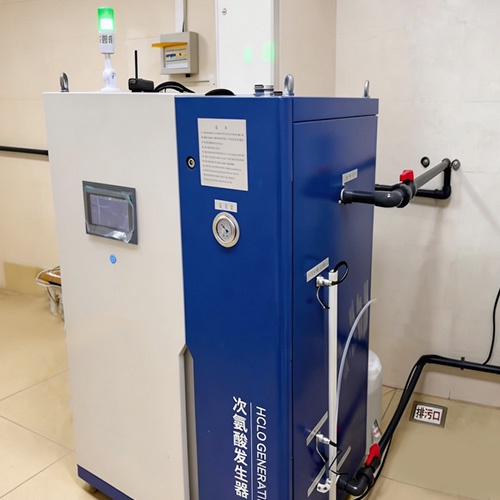
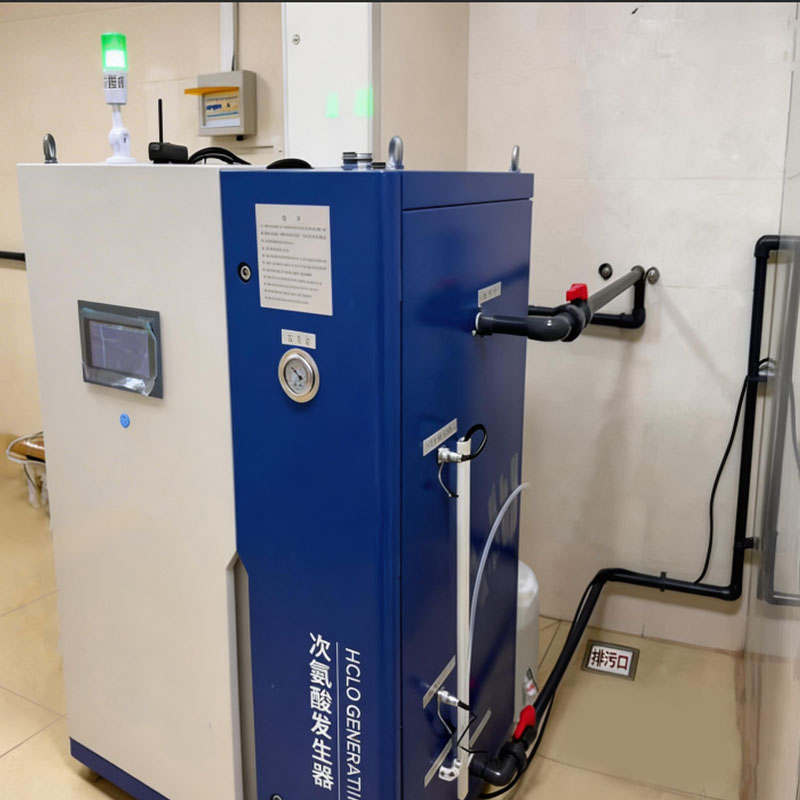
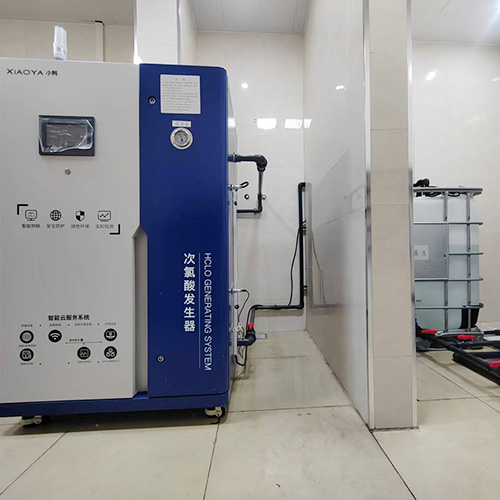
The Hypochlorous Acid Generator for Catering Disinfection is presented for catering applications. Its published specifications describe production capability, rather than demonstrating validated hospital disinfection performance.
Additional published details include a five-liter electrolyte tank and dimensions of 500 × 510 × 1500 millimeters. Check service access, refill frequency, and installation space.
References to “US FDA” need an identifiable regulatory status and scope. GB 14881 addresses food production hygiene; it does not establish hospital disinfectant authorization.
Treat claims such as “zero harm,” “non-corrosive,” “residue-free,” or “no secondary rinsing” as statements requiring substantiation for each intended surface, exposure route, and use condition.
A supplier integrating research, production, and operations may offer useful customization. Request documented design controls, change management, service arrangements, and evidence supporting any hospital-specific configuration.
Can Staff Meet Contact Times and Protect Equipment?
A suitable solution still needs a workable application process. Compare required wet contact times with room turnover targets and the time surfaces actually remain wet.
Define cleaning before disinfection, including removal of visible soil. Organic contamination can reduce chlorine performance, so laboratory efficacy cannot replace appropriate preparation of hospital surfaces.
Evaluate the proposed cloths, mop systems, bottles, and dispensing equipment. Confirm that application delivers the required concentration and coverage without introducing avoidable handling problems.
Obtain compatibility information for bed rails, stainless steel, coated furniture, plastics, rubber seals, and electronics. Follow equipment manufacturers’ instructions, particularly around screens and electrical connections.
Do not extend surface-use evidence to fogging, inhalation exposure, wound care, or hand antisepsis. Each application needs its own authorization, efficacy evidence, and safety assessment.
Train environmental services staff on dilution restrictions, container labeling, wet contact time, protective measures, and prohibited chemical mixing. Demonstrate the procedure using normal cleaning equipment.
What Quality Controls and Maintenance Must Be Built In?
Assign responsibility for releasing generated solution before routine use. Establish documented checks at frequencies justified by system reliability, validated procedures, and the consequences of failure.
Use a measurement method appropriate to the required concentration range. Verify instrument calibration, reagent expiry, sampling technique, and potential interference from the generated formulation.
Maintain records linking production time, measured concentration, pH, operator, and disposition. Where practical, connect batches to dispensing locations so rejected solution can be traced.
Assess feed-water requirements, including hardness and any pretreatment needs. Ask how scaling, electrolyte depletion, or electrode deterioration affects output and how operators detect these conditions.
Request a maintenance schedule with tasks, consumables, labor requirements, spare-part availability, and expected downtime. Clarify what the electrolyzer service-life claim covers under your operating conditions.
Calculate cost per usable liter, including electrolyte, water, electricity, testing, labor, containers, servicing, and rejected batches. Rated electrical power alone cannot predict overall operating cost.
What Should a Hospital Pilot Prove Before Purchase?
Run a supervised pilot involving infection prevention, environmental services, facilities engineering, and procurement. Agree on acceptance criteria before testing, with clear responsibilities for interpreting results.
Measure concentration and pH during representative production cycles, including peak demand. Check solution quality at dispensing points and after the proposed storage period as well.
Observe cleaning staff completing real tasks. Record refill delays, wet contact time compliance, labeling errors, handling difficulties, and whether required quality checks remain practical during shifts.
Exercise alarm and recovery procedures safely. Verify that staff can recognize unsuitable output, prevent its use, obtain backup supplies, and restart production according to documented instructions.
Select a Medical Hypochlorous Acid Generator only when regulatory evidence, verified output, material compatibility, and operational controls align with the hospital’s specific cleaning requirements and resources.
The strongest procurement decision is supported by demonstrated workflow performance: usable solution when needed, repeatable quality, manageable maintenance, and staff who can apply it correctly.