news
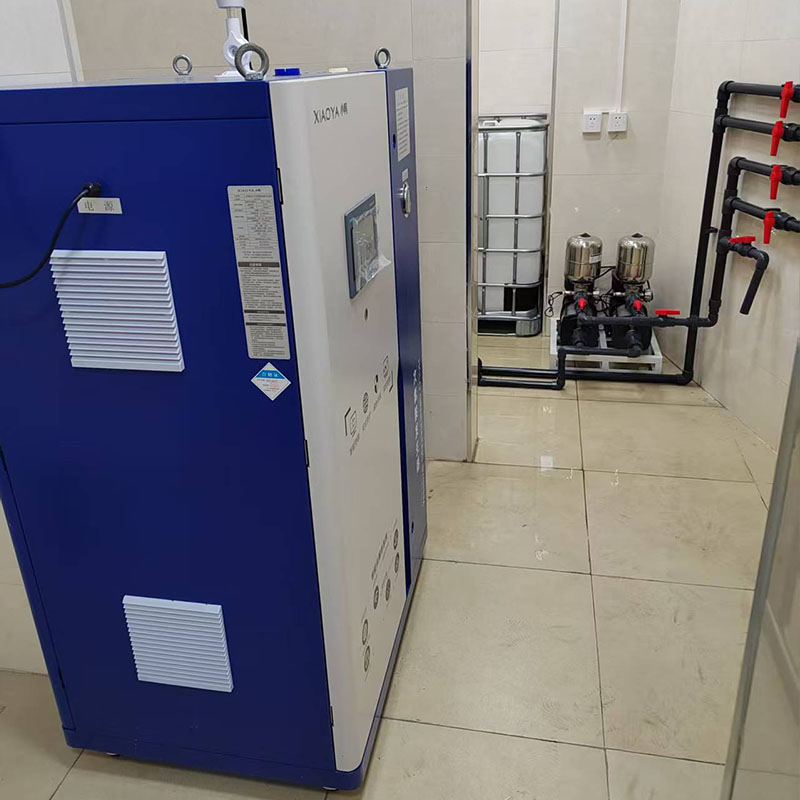
A public facility’s HOCl generator should be sized around its busiest cleaning window, the volume that must remain available during interruptions, and the concentration required at the point of use. Average daily consumption helps estimate operating hours, but it can hide a shortage when several teams refill equipment before a building opens or immediately after an event.
For facilities with concentrated cleaning schedules, a generator paired with appropriately sized buffer storage can meet demand without matching every momentary dispensing surge. That approach works only when stored solution retains its required quality, the tank can recover before the next peak, and the distribution system delivers enough flow to simultaneous users.
Build a demand profile around cleaning windows
Start with liters of usable solution required by each cleaning operation. Floor area alone is a weak sizing basis: application methods, equipment fill volumes, surface conditions, and cleaning procedures all affect consumption. Separate routine daytime use from opening preparation, event turnover, restroom servicing, and other periods when several teams draw solution together.
Use measured dispensing volumes where available. For a new facility, build an estimate from planned equipment fills and application procedures, then identify the assumptions that need checking during commissioning. Include line flushing, discarded solution, and other predictable losses, without applying an unexplained percentage to every demand category.
The resulting demand profile should answer four questions:
- How much solution is consumed over a full operating day?
- How much is drawn during the busiest cleaning window, and how long does that window last?
- What is the highest simultaneous dispensing flow?
- How much time is available to replenish storage before another peak?
Keep cleaning and disinfection requirements distinct. HOCl capacity should follow the facility’s approved procedures, including any preceding cleaning step and required wet contact time. Increasing concentration to reduce liquid consumption is not a valid sizing shortcut unless the intended use permits that concentration and application method.
For illustration, assume a facility needs 2,000 liters daily, including 900 liters during a 90-minute morning window. These are hypothetical design inputs. The daily volume could suggest a modest generator running for several hours, while the morning window requires an average supply of 600 L/h. Short bursts within that window may demand substantially higher dispensing flow.
Size generation and storage together
A useful starting calculation is:
Required usable buffer = peak-window consumption − generation during that window + planned reserve.
This calculation assumes production is available throughout the window. If startup, quality checks, or scheduled downtime interrupt generation, count only the time when acceptable solution actually enters the tank. For irregular demand, calculate inventory at successive time intervals; a single average can conceal an early shortage.
In the illustrative facility, a generator delivering 400 L/h of acceptable solution produces 600 liters during the 90-minute peak. The remaining 300 liters must come from storage. Adding a separately defined 100-liter operating reserve gives a required usable buffer of 400 liters at the start of the window.
Usable storage is smaller than nominal tank capacity when low-level cutoffs, pump suction requirements, or headspace restrict the operating range. If the proposed tank arrangement makes 80% of its nominal volume usable, this example requires a 500-liter tank. That 80% is an assumed design condition, not a general rule; the actual working volume must come from the tank and pump arrangement.
Recovery determines whether this combination works throughout the day. After the morning peak, the tank has lost 300 liters of inventory. With no further demand, a 400 L/h generator replaces that drawdown in 45 minutes. If other teams continue consuming 200 L/h, net replenishment falls to 200 L/h and recovery takes 90 minutes. A second peak arriving sooner would require more initial storage, greater production capacity, or a revised cleaning schedule.
The same generator needs five productive hours to make 2,000 liters. Allow additional production for identified losses, and check that the operating schedule leaves room for maintenance and recovery. A tank can shift production to quieter periods, but it cannot compensate indefinitely for inadequate daily output.
Compare a few workable combinations rather than selecting the largest machine available. Higher generation capacity may reduce storage and recovery time. Larger storage may support clustered cleaning demand, but it increases solution residence time and requires space, suitable materials, and a defined turnover policy.
Compare capacity at the required solution quality
A headline L/h rating is useful only alongside the available chlorine concentration, pH, feedwater conditions, and operating duty under which it is achieved. Ask for output at the facility’s intended concentration and installation conditions. Do not assume that maximum flow and maximum concentration are available simultaneously.
The required concentration should follow the applicable product authorization and facility procedure for the intended surfaces and use. Available chlorine concentration is not interchangeable with the amount of HOCl present under every pH condition. Technical evaluation should therefore consider both concentration and pH, including their acceptable ranges at dispensing.
As a specification example, the AQ-P1000 Hypochlorous Acid Generator for Animal Husbandry and Breeding lists production capacity of 1,000 L/h, an available chlorine concentration range of 10–300 mg/L, and a pH value of 6.37. Its stated inlet water pressure is 0.15–0.25 MPa. These figures illustrate the parameters that belong in a capacity comparison, although its livestock application does not establish suitability or authorization for public-facility disinfection.
For equipment with this type of specification, request the production rate at the selected concentration, allowable feedwater quality, startup time, and performance over the intended duty cycle. A stated component life also needs an operating definition: the AQ-P1000 lists electrolyzer service life of at least 3,000 hours, but maintenance planning still depends on service conditions, replacement criteria, and replacement time.
Storage adds a separate quality constraint. Specify tank materials, protection from light and excessive heat, cleaning access, and maximum permitted holding time supported by stability evidence for the solution and installation. Avoid assigning a universal shelf life to generated HOCl. Acceptance should include checks at dispensing points after representative storage periods, rather than relying exclusively on a reading at the generator outlet.
Make peak delivery and downtime part of acceptance
Generation capacity and dispensing capacity are different duties. If four stations each require 12 L/min, the distribution system must supply 48 L/min during simultaneous filling. A 400 L/h generator contributes approximately 6.7 L/min; the tank supplies the balance. Pump selection, pipe sizing, pressure losses, and usable tank inventory determine whether staff can actually refill on schedule.
Controls should make that operating arrangement dependable. Define tank level thresholds for starting and stopping production, low-level protection for dispensing pumps, and alarms for production faults. Where concentration or pH monitoring is fitted, specify measurement checks and the response to out-of-range solution. Automatic diversion or dispensing inhibition should follow the facility’s quality requirements.
Reserve capacity needs a stated purpose. The 100-liter reserve in the example provides limited operational flexibility; it does not establish coverage for a lengthy generator outage. Determine interruption coverage from essential demand during the expected repair period, then consider validated stored inventory, redundant production, or an approved alternative disinfectant supply. Any redundant arrangement should also account for shared dependencies such as power, feedwater, and controls.
The purchase specification should describe a representative operating sequence: starting inventory, required solution quality, simultaneous fills, cleaning-window consumption, and recovery before the next peak. Acceptance should demonstrate delivery under that sequence, including relevant alarm and shutdown behavior. A defensible equipment choice leaves evaluators able to show when the tank reaches its lowest usable level, how quickly it recovers, and what cleaning operations remain supported when production stops.
NEWS
 Sizing a Public Facility HOCl Generator for Peak Cleaning Demand
- What Can a Hypochlorous Acid Generator Do for Public Facility Cleaning?
 WS/T 10053-2026 Includes the Compound Method for the First Time: Standard Signals and Market Opportunities for Mass Agricultural Production of Hypochlorous Acid Generators
 Evaluating HClO Generator Lifecycle Costs Beyond the Initial Equipment Price
 HClO Generator pH Control: Why It Determines Disinfection Performance
Leave us a message

Xiaoya Group was founded in 1979,expert in the electrolyzed water industry.
Get in Touch
*We respect your confidentiality and all information are protected.