news
Which Safety Features Matter Most When Buying an HClO Generator?
For procurement teams, choosing an HClO generator is not only about output capacity and operating cost. The more consequential question is whether the system can produce and handle hypochlorous acid reliably without creating unnecessary risk for operators, nearby equipment, or the facility itself. In healthcare, commercial disinfection, food-adjacent environments, and public hygiene applications, a low purchase price can quickly lose its appeal if the unit requires frequent intervention, corrodes surrounding infrastructure, or lacks meaningful safeguards when water quality or operating conditions change.
An HClO generator typically depends on controlled electrochemical processes, water quality, salt input, flow stability, and concentration management. That makes safety a system-level issue rather than a single feature on a specification sheet. The strongest buying decisions examine what happens during normal operation, but also what the machine does when something is not normal.
Start with containment: leaks, ventilation, and material compatibility
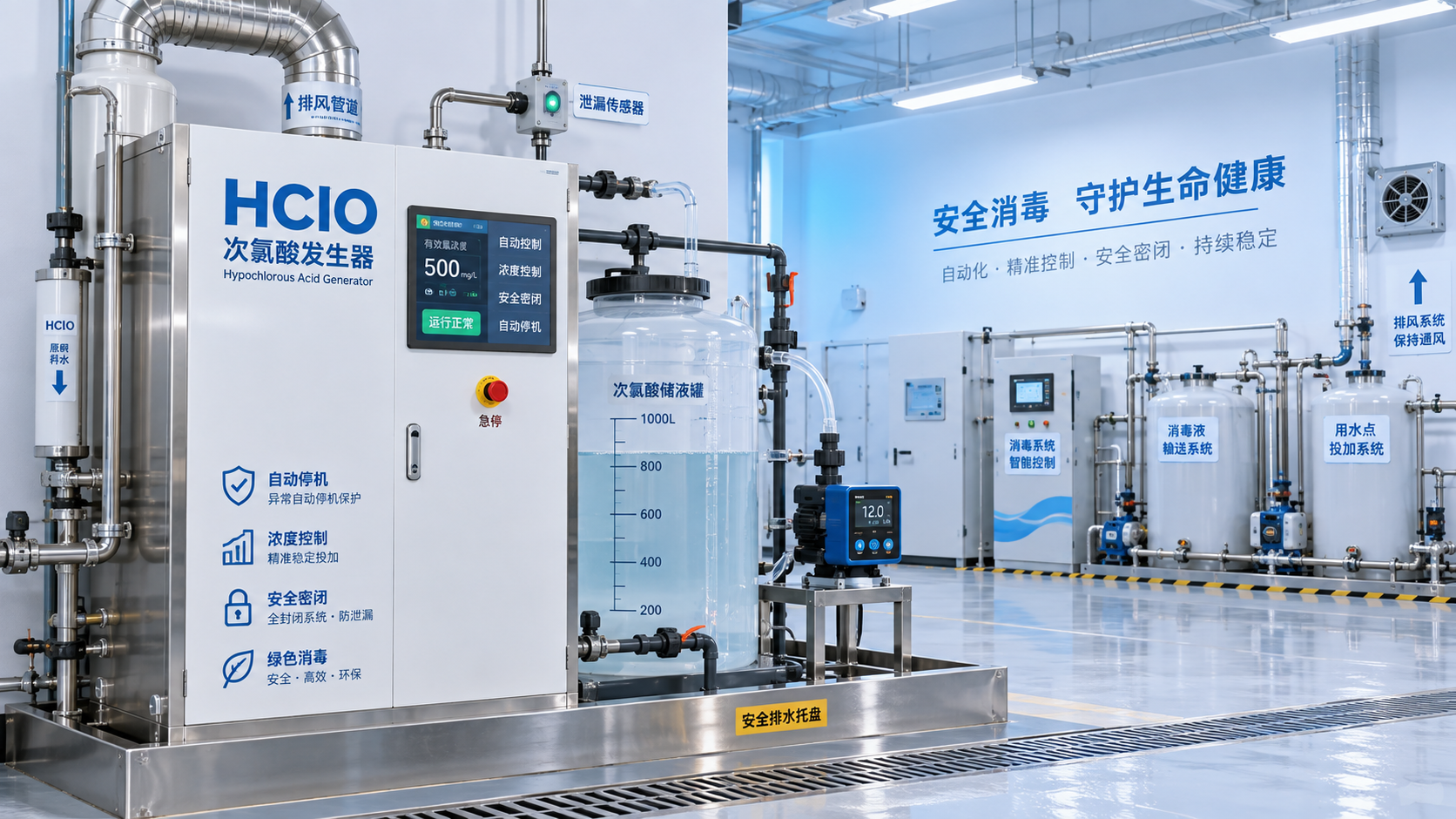
Any disinfection generator handling saline feedwater, oxidizing solutions, or electrolysis by-products should be evaluated for containment before output claims. Ask where liquid can escape: hose connections, dosing ports, storage tanks, drain lines, pump seals, electrode chambers, and service access points. A supplier should be able to explain the location of leak detection, drip management, overflow protection, and the shutdown logic triggered by a leak alarm.
Ventilation deserves the same scrutiny. Under certain fault conditions, electrochemical equipment may generate gases that need to be safely managed. The appropriate arrangement depends on generator design, installation room size, output scale, and local requirements, but the question should never be omitted from a technical review. Confirm whether the unit needs a dedicated exhaust connection, gas monitoring, ventilation interlock, or restrictions on installation near ignition sources and poorly ventilated utility rooms.
Material selection is less visible but affects both safety and lifetime. Hypochlorous acid solutions, chlorine-containing feedwater, and salt residues can be hard on unsuitable metals, seals, and fittings. Procurement documentation should identify wetted materials, tank construction, tubing type, valve materials, and recommended compatible accessories. “Corrosion-resistant” is not enough on its own; it should be tied to the actual solution concentration, temperature, and intended use conditions.
Automatic shutdown is more valuable than a warning light
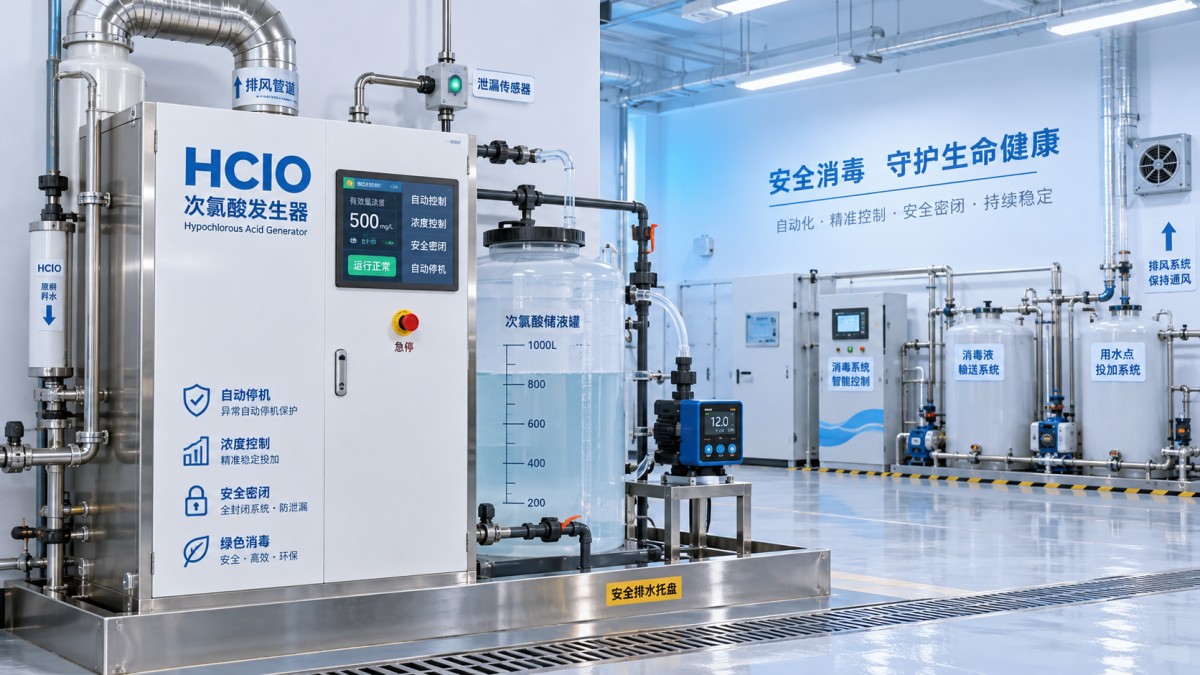
An alarm tells someone that attention is needed. A well-designed protective shutdown prevents a developing fault from becoming an operator exposure, chemical spill, or equipment damage event. When comparing an HClO generator, request a clear list of monitored fault states and the corresponding machine response.
Useful interlocks commonly address low water pressure, no-flow conditions, abnormal feedwater quality, over-temperature, tank high level, pump failure, low salt supply where applicable, electrical faults, and access-panel opening. The critical distinction is whether the machine merely records an alarm or stops electrolysis, dosing, or transfer operations in a controlled way. A manual reset requirement after a critical fault can also be preferable to automatic restart, particularly where personnel may be working nearby.
Remote monitoring can strengthen this protection, but only when it provides actionable information. For unattended or multi-site facilities, verify which conditions are visible remotely, whether alert history can be exported, and what happens during network loss. Connectivity should not replace local safeguards; the equipment still needs to enter a safe state without relying on a cloud platform or mobile notification.
Concentration control protects both the application and the operator
The concentration of available disinfecting species is central to whether the generated solution is suitable for its intended application. A concentration that drifts too low may undermine a disinfection process. One that is higher than expected can increase compatibility concerns, handling risk, odor, and the likelihood of damage to sensitive surfaces.
For that reason, buyers should distinguish between a nominal concentration setting and actual concentration monitoring. Ask how the generator verifies production consistency, how often sensors require calibration or replacement, and whether the system compensates for changes in water conductivity, temperature, flow, or electrode condition. If the solution is stored before use, clarify how long it remains within the required operating range under the planned storage conditions. This is not a detail to leave to the commissioning stage.
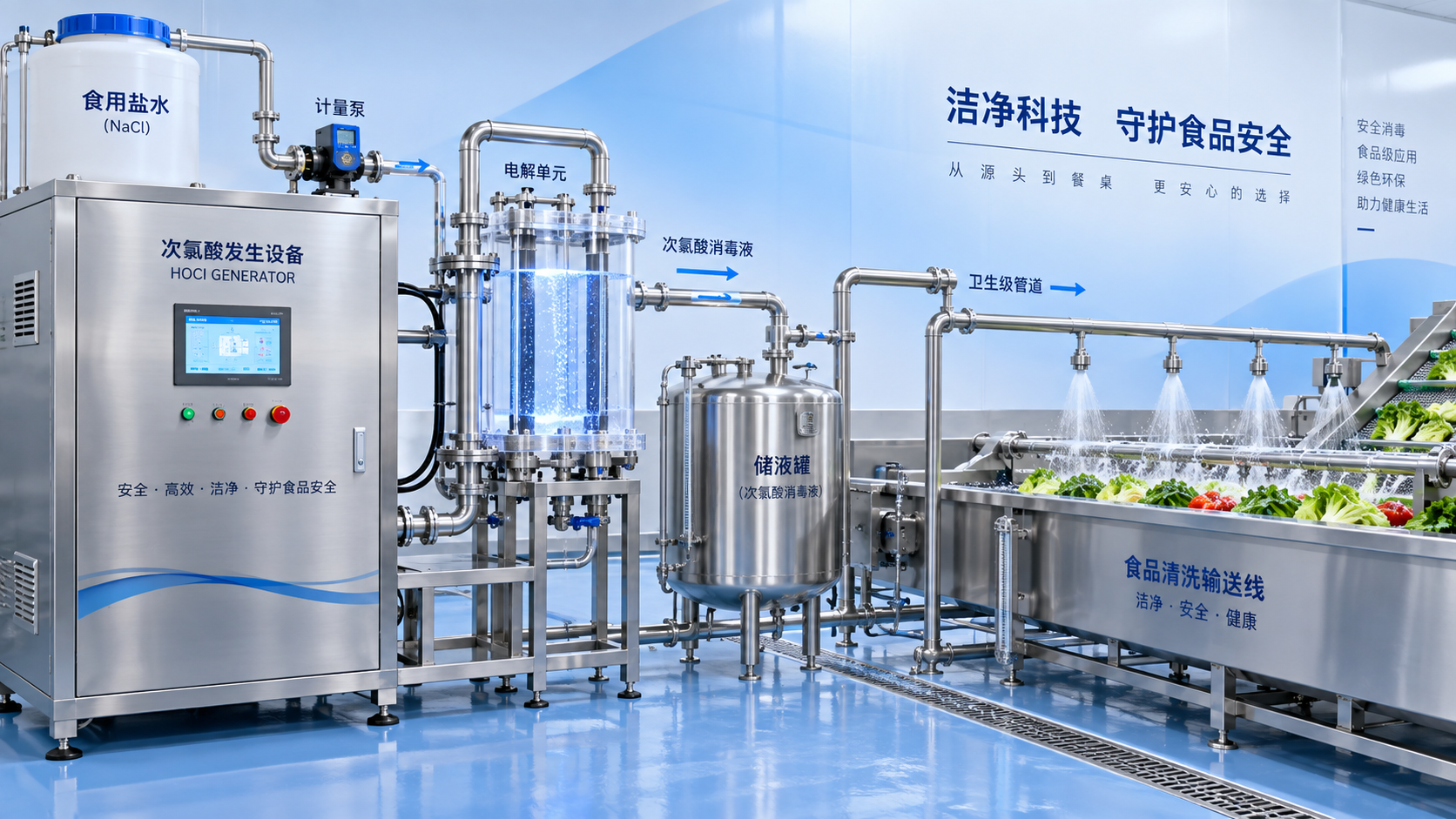
The same review should cover dosing controls. A generator may produce stable solution yet still deliver an unsuitable dose if the transfer pump, flow meter, or injection control is poorly matched to the point of use. In automated cleaning and disinfection installations, production, storage, and dosing should be treated as one safety chain.
Feedwater quality is a safety requirement, not only a performance variable
Incoming water influences electrode life, solution consistency, scaling, sensor reliability, and maintenance frequency. Poor pretreatment can turn a normally stable generator into a source of repeated alarms and unpredictable output. Before selecting equipment, obtain a water analysis or, at minimum, confirm the available site data for hardness, suspended solids, conductivity, and other conditions relevant to the proposed process.
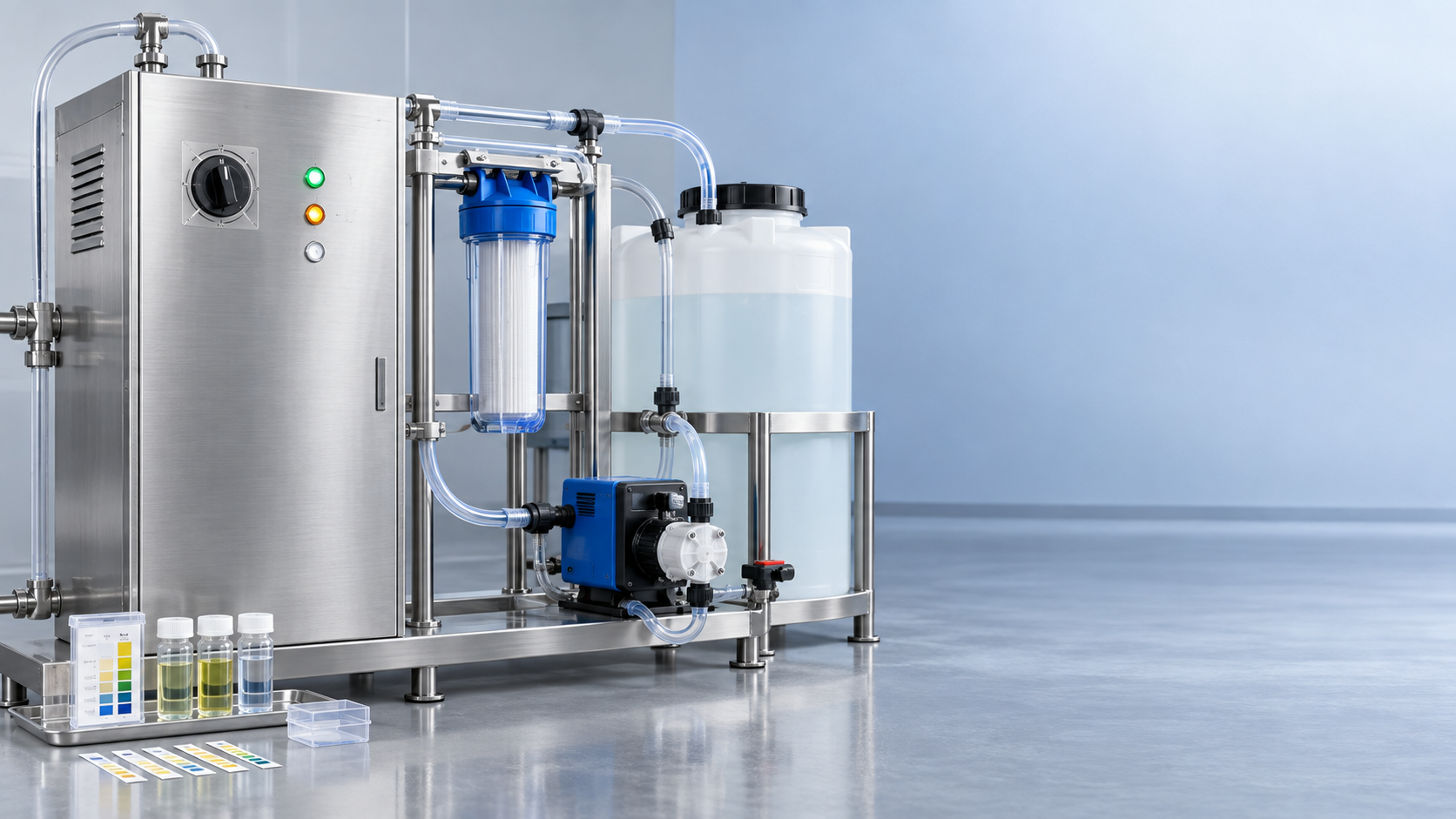
Where suspended solids or microbiological control are concerns, pretreatment may need to be included in the scope rather than treated as a customer-side utility. For example, a Water purification system combining ultrafiltration and UV-C treatment can be considered upstream where its capacity and installation design fit the project. Its hollow-fiber PVC ultrafiltration membrane is specified at 1000 L/H, while the UV stage has a maximum sterilization capacity of 0.35 T/H at a 254 nm wavelength. These figures should be checked against the actual generator demand, peak flow profile, and required water-quality target rather than assumed to be universally suitable.
Maintenance data matters here as well. A stated membrane lifespan of three to five years depends on incoming water quality, and a UV lamp designed for 8,000 hours is recommended for replacement after 7,200 hours. Those are planning inputs, not guarantees. A responsible specification includes access space, replacement procedures, isolation valves, and a service schedule for the entire water-to-solution chain.
Electrical and mechanical safety should match the installation reality
It is easy to focus on chemistry and overlook the fact that the generator is also an automated electrical machine installed around water. Enclosure protection, cable routing, grounding provisions, emergency-stop arrangements, access control, pump guarding, and safe drainage all deserve review. The required level of protection depends on where the system will be installed: a controlled plant room, a healthcare utility area, a kitchen support zone, or a commercial cleaning environment each creates different exposure risks.
Request dimensional drawings early. They reveal whether technicians can safely reach filters, electrodes, sensors, tanks, and drain points without moving the unit or working over live connections. They also expose a common oversight: a machine may fit physically, but its service envelope may not. This is particularly important for integrated systems involving storage tanks, pretreatment modules, dosing cabinets, or external ventilation equipment.
Evaluate the supplier’s engineering discipline, not only the machine
Safety features are only as dependable as the engineering and support behind them. A supplier involved in research and development, production, and operation is generally better positioned to explain the practical interaction between components, controls, water conditions, and servicing. This is especially relevant for organizations serving kitchen and bathroom appliances, healthcare and disinfection equipment, clean-energy products, and small household appliances, where different markets may require different integration methods and operating expectations.
During evaluation, ask for the commissioning sequence, operator training scope, maintenance responsibilities, spare-part list, alarm-response guidance, and documentation available for the destination market. If certification, electrical compliance, chemical handling rules, or wastewater requirements apply, confirm them against the local project requirements rather than relying on generic statements.
The safest HClO generator is not necessarily the one with the longest feature list. It is the one whose containment, monitoring, shutdown logic, materials, water treatment, and service plan suit the actual installation. Before issuing a purchase order, turn those points into acceptance criteria. That makes it easier to compare suppliers on the risks that will remain after the equipment has been installed and handed over.
NEWS
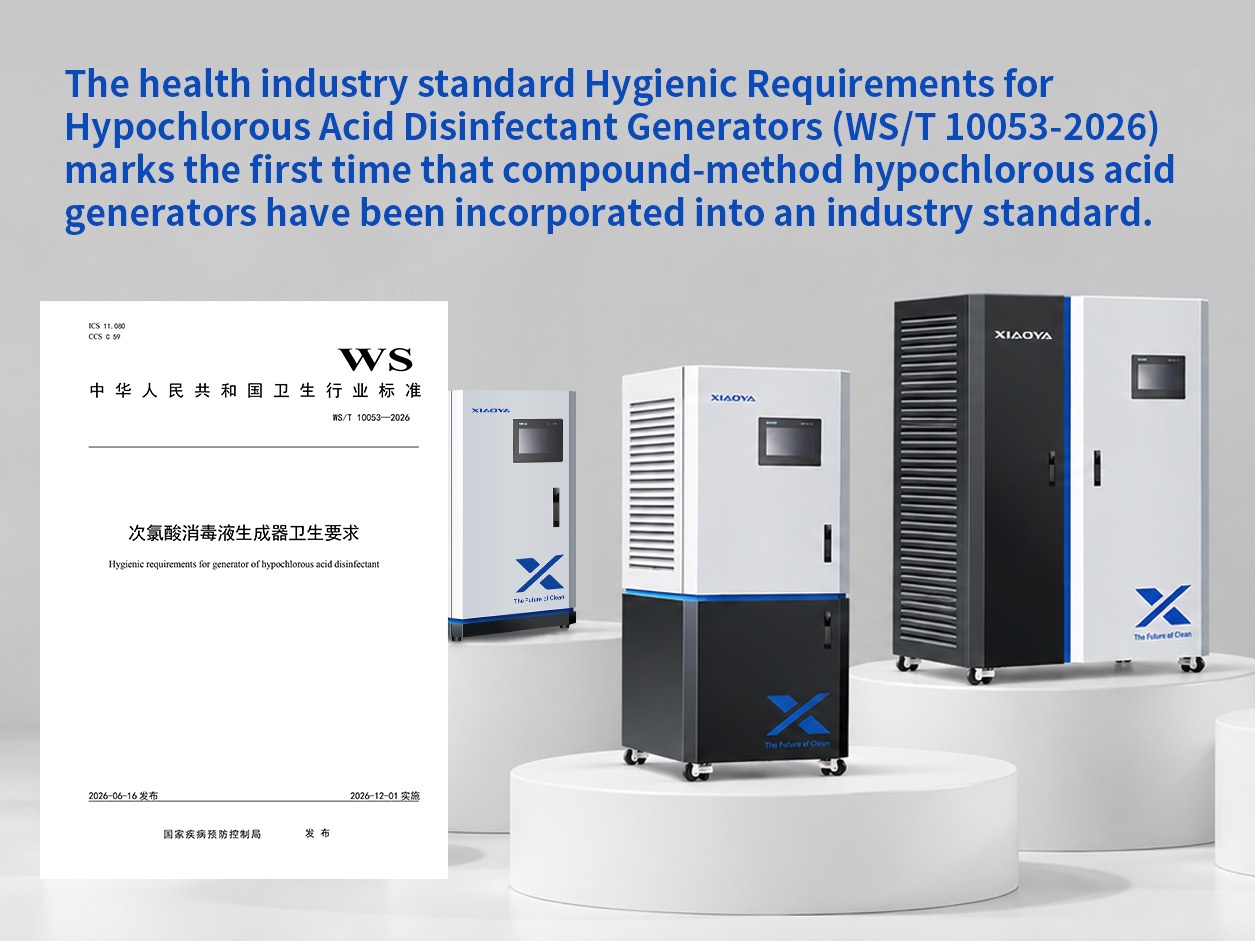
 WS/T 10053-2026 Includes the Compound Method for the First Time: Standard Signals and Market Opportunities for Mass Agricultural Production of Hypochlorous Acid Generators
 Which Safety Features Matter Most When Buying an HClO Generator?
 Troubleshooting Low ORP Readings on a Hypochlorous Acid Machine
- A Buyer’s Checklist for Comparing Hypochlorous Acid Machine Specifications
- Hypochlorous Acid Machine Fundamentals: From Electrolysis to Usable HClO
Leave us a message

Xiaoya Group was founded in 1979,expert in the electrolyzed water industry.
Get in Touch
*We respect your confidentiality and all information are protected.