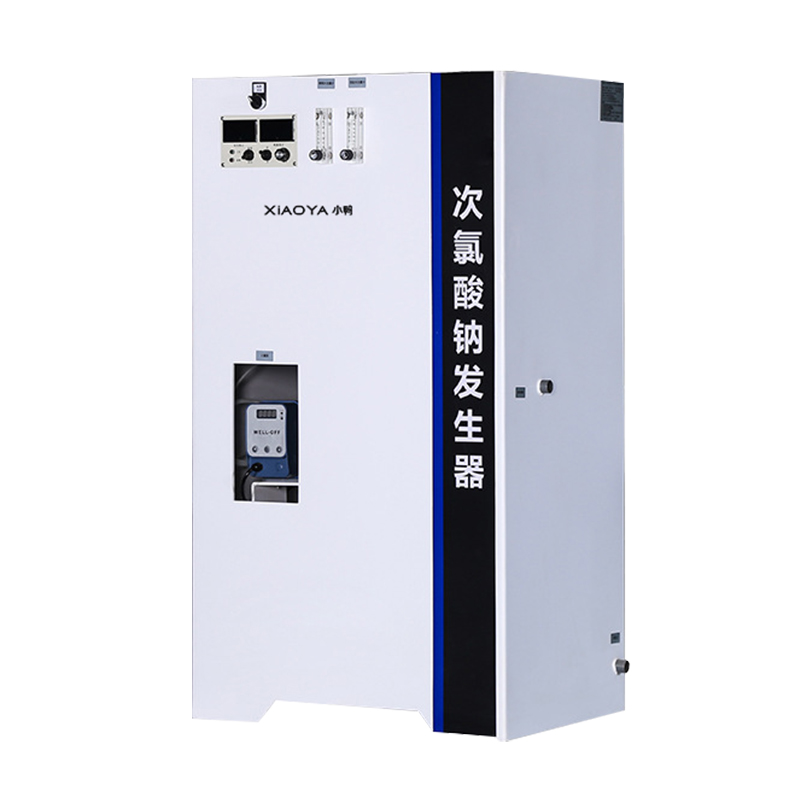
For business decision-makers, the real question is not whether an HClO generator sounds safer in theory. It is whether on-site disinfectant generation can materially reduce the operational burden and exposure that come with storing, moving, dosing, and replacing conventional chemicals every day. In many facilities, the answer is yes, but only when the system is matched to the use case, the output is controlled, and the surrounding process is designed with the same discipline as any other automated utility.
That distinction matters. Chemical storage risk is rarely just about having drums or containers on site. It also includes manual handling, inconsistent dilution, ventilation concerns, transport within the plant, stock aging, emergency response planning, and the administrative overhead tied to hazardous materials management. An HClO generator changes that risk profile because it shifts part of the disinfection workflow from chemical logistics to equipment operation.
Why the storage question matters more than it first appears
In daily disinfection routines, especially across healthcare support spaces, appliance manufacturing, clean environments, and facility management, operators often rely on packaged chemicals that arrive concentrated and require storage controls. Even when the chemistry is familiar, the routine can become fragile: inventory runs low, solution strength drifts after dilution, containers are exposed to heat or light, and frontline staff end up making process decisions that should really be engineered into the system.
An HClO generator addresses this by producing disinfectant on site, closer to the point of use. That usually means smaller volumes of precursor materials, less dependence on delivered finished chemicals, and fewer touchpoints where people must manually open, transfer, or mix solutions. For companies trying to improve both EHS performance and workflow consistency, that is often the main reason the technology gets serious attention.
Still, “reduced storage risk” should not be read as “no risk.” The risk moves. You may store less finished disinfectant, but you now need to manage generation equipment, process water quality, electrical reliability, output verification, and maintenance discipline.
Where an HClO generator makes practical sense
The strongest fit is usually in operations where disinfection is frequent, repetitive, and operationally important enough to justify process control. That can include healthcare-related environments, sanitation lines in appliance production, central facility hygiene systems, and water-treatment-adjacent applications.
It tends to be more compelling when several of these conditions are true:
- Daily or multi-shift disinfection creates meaningful chemical consumption.
- Finished chemical storage occupies controlled space or creates internal transport burden.
- Output consistency matters for audits, hygiene performance, or product-contact environments.
- The site already has a basic automation mindset and can manage routine equipment upkeep.
- There is a need to reduce manual mixing and operator-dependent dilution steps.
If your actual demand is low, intermittent, or highly decentralized across many small locations, the economics and operational logic may be weaker. In those cases, buying ready-made disinfectant may remain simpler, even if it is less elegant from a process-engineering perspective.
What risk is reduced, and what risk replaces it
Decision-makers often hear a broad claim that on-site generation is safer because it reduces stored chemicals. That is directionally true, but it deserves a more precise reading.
What usually improves:
- Lower inventory of concentrated disinfectants on site.
- Fewer manual transfers, dilutions, and container changes.
- Less degradation from prolonged storage of finished solution.
- Better alignment between production volume and actual demand.
- More predictable routine when the generator is integrated into SOPs.
What must still be managed carefully:
- Generator output stability and concentration verification.
- Water quality and salt solution quality, where applicable.
- Ventilation and by-product handling.
- Maintenance of electrodes, pumps, sensors, and dosing components.
- Operator training for startup, shutdown, cleaning, alarms, and abnormal conditions.
This is the key business judgment: an HClO generator reduces a chemical storage problem by turning it into a controlled equipment-and-process problem. For most industrial and institutional buyers, that is a favorable trade only if they are set up to run equipment reliably.
The automation angle is often undervalued
In the automation equipment sector, the appeal is not just chemistry. It is process repeatability. A well-selected system can turn disinfection from a labor-dependent task into a monitored utility with defined inputs, defined output ranges, and clearer accountability.
That matters in businesses where hygiene is tied to uptime, quality claims, or cross-department coordination. A generator can support timed production, centralized dosing, and lower variability between shifts. It can also reduce the common gap between what the SOP says and what operators actually prepare in buckets, tanks, or spray units.
For enterprise buyers, this is often where ROI becomes more credible. The value may come less from replacing a chemical line item and more from reducing routine handling, improving compliance behavior, and lowering avoidable process variation.
Common assumptions that do not always hold up
One common assumption is that all on-site generated disinfectants are automatically equivalent in stability and efficacy across every use condition. They are not. Actual performance depends on generation method, concentration control, storage time after generation, application method, and the soil load in the real environment. Buyers should ask for use-case-specific validation rather than relying on generic claims.
Another assumption is that “using salt and water” means the system is operationally simple. The chemistry inputs may be simple, but the installation is still an industrial system. Water quality, scaling, venting, electrical integration, alarm logic, and service intervals all affect real-world reliability.
A third misconception is that reducing stored chemicals eliminates safety planning. It does not. For example, some electrolytic systems generate hydrogen as a by-product, which means gas management and equipment design should be reviewed carefully. That is one reason buyers evaluating electrolytic disinfection equipment should look closely at how by-products are handled, not just at the advertised disinfectant output.
What to evaluate before procurement
For a decision-maker comparing technologies or suppliers, the right evaluation framework is broader than output capacity.
1. Match the system to the operating pattern
Start with demand profile: how much disinfectant is needed, at what concentration, at what times, and across how many points of use. A system sized for peak marketing claims rather than actual workflow can become either underutilized or operationally stressed.
2. Look at input and output control
Ask how the system manages feed quality, concentration stability, and dosing repeatability. “On-site generation” is only valuable if the resulting solution is suitable for your actual sanitation protocol.
3. Review by-product handling and equipment safety
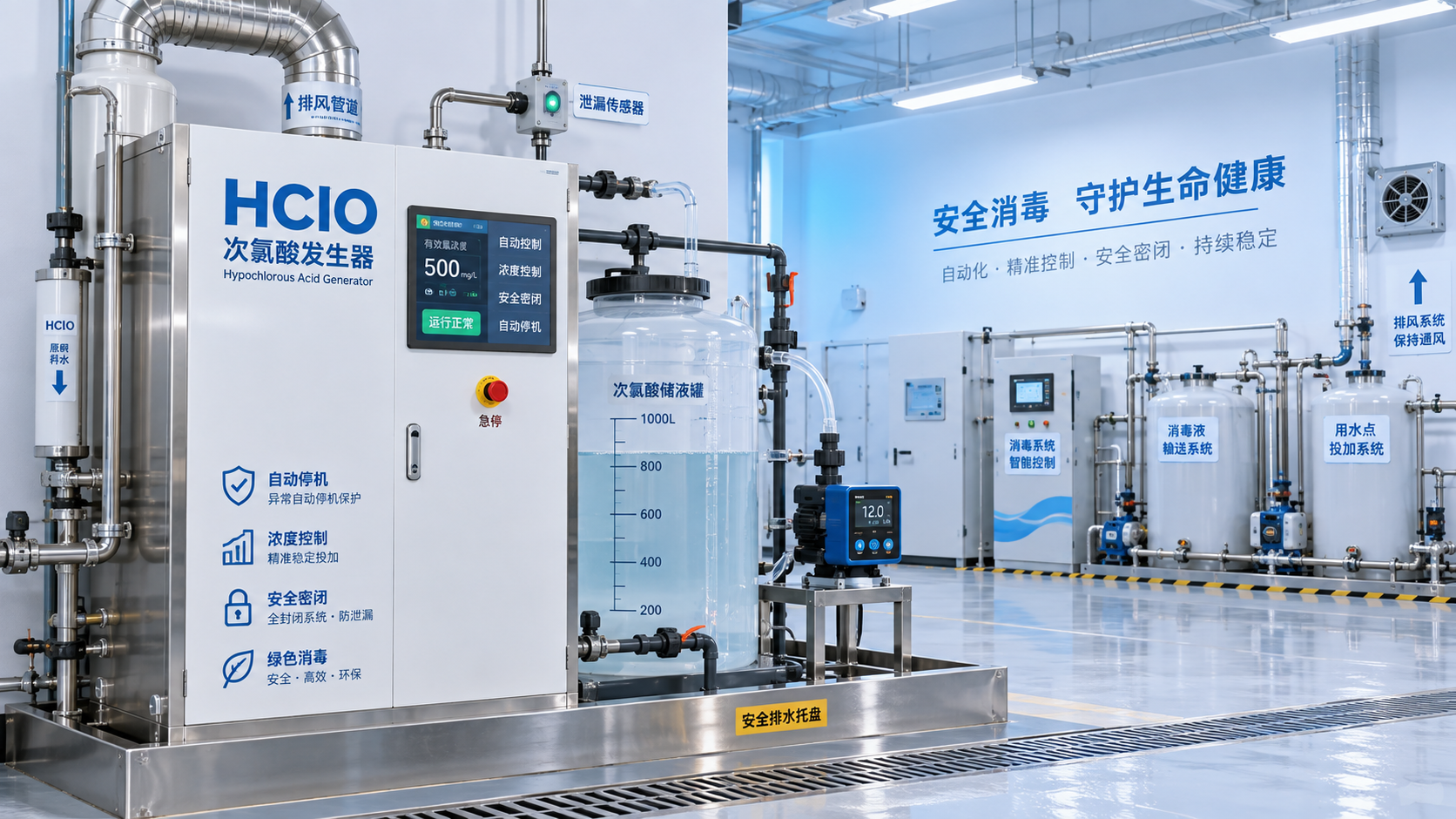
If the technology involves electrolysis, understand what gases or secondary outputs are produced and how they are removed or controlled. In this category, some suppliers offer membrane-free electrolysis systems using low-concentration sodium chloride solution to produce sodium hypochlorite on site. For instance, a solution such as Sodium Hypochlorite Electrolyzer is built around membrane-free electrolysis and a push-type hydrogen removal approach, intended to help hydrogen evolve and discharge quickly with circulating flow. That kind of design detail is not a marketing footnote; it is directly relevant to installation review and risk assessment.
4. Check maintenance reality, not brochure simplicity
Electrodes, pumps, control components, and circulation paths all need maintenance. Ask what routine upkeep is required weekly, monthly, and annually, and whether your site team can realistically absorb it without depending on constant vendor intervention.
5. Confirm regulatory and documentation fit
Depending on geography and application, buyers may need to verify local requirements related to disinfectant use, workplace safety, water treatment, emissions, or equipment certification【待核实】. This part is easy to underestimate when procurement is driven mainly by operations or engineering.
Why sodium hypochlorite generation sometimes enters the same conversation
Some buyers searching for an HClO generator are not committed to one chemistry pathway yet. They are really comparing families of on-site disinfection generation technologies: what can be produced on site, how stable it is, what handling burden remains, and how the equipment behaves in continuous operation.
That is why sodium hypochlorite generation equipment often appears in the evaluation set, especially in water treatment equipment and electrolytic disinfection devices. A membrane-free system based on diluted sodium chloride can be attractive where buyers want to avoid additional chemical agents and reduce dependence on delivered disinfectant stock. But the suitability still depends on the disinfection target, contact method, compatibility with downstream materials, and the site’s tolerance for maintenance and process supervision.
The practical bottom line for enterprise buyers
An HClO generator can reduce chemical storage risks in daily disinfection routines, and in many operating environments that is a meaningful improvement. But the benefit is strongest when buyers frame it correctly: this is not simply a safer chemical container. It is a process conversion from stored chemistry to managed generation.
If your business runs frequent disinfection cycles, needs tighter control, and already thinks in terms of automated utility systems, the model is often worth serious evaluation. If your site struggles with maintenance basics or lacks process ownership after installation, the same technology can underperform despite sounding safer on paper.
The best procurement decisions in this area come from mapping the whole chain: input materials, generation method, by-products, dosing workflow, maintenance load, and operator behavior. Once that chain is visible, it becomes much easier to tell whether the risk is truly being reduced or simply moved somewhere less obvious.
NEWS
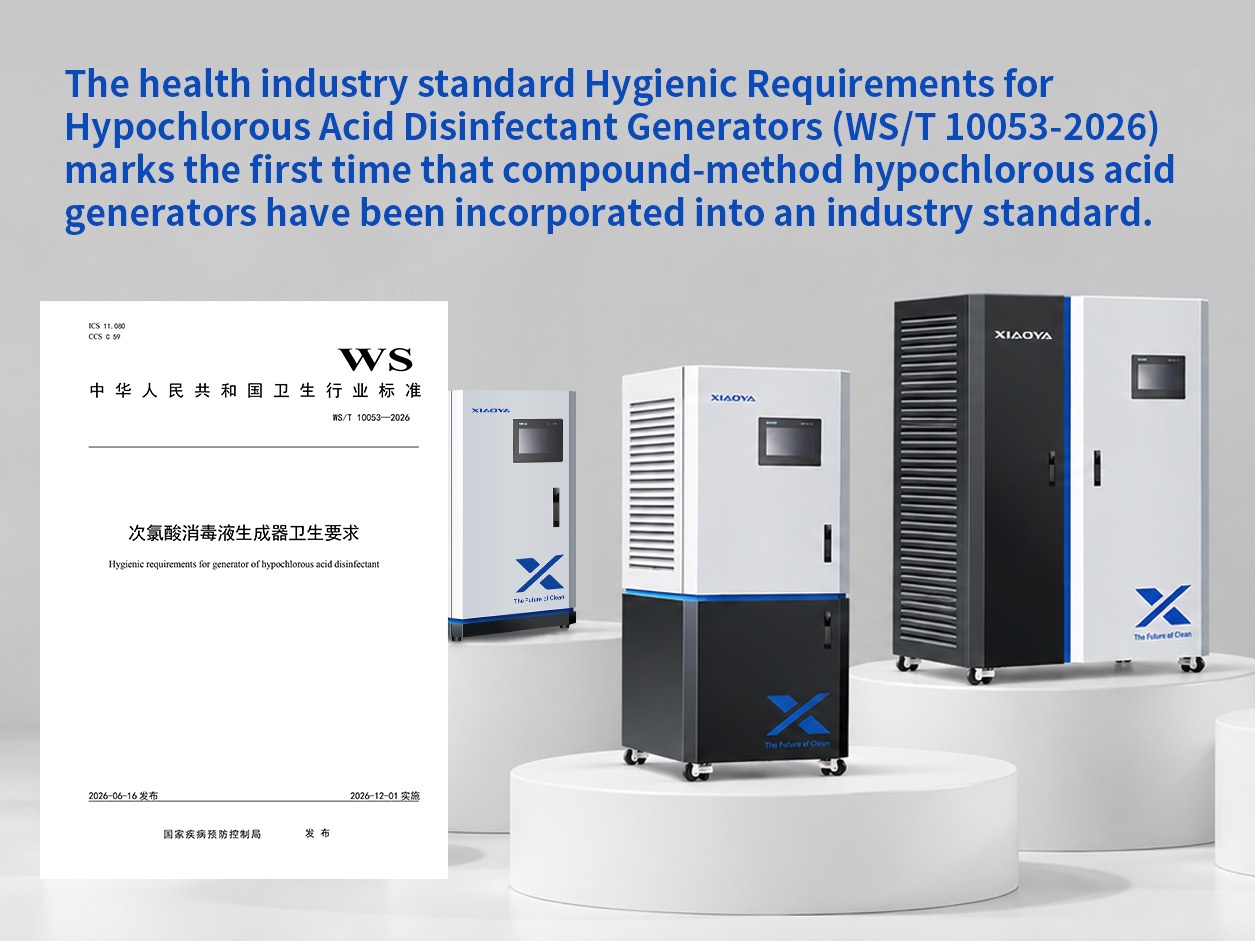
 WS/T 10053-2026 Includes the Compound Method for the First Time: Standard Signals and Market Opportunities for Mass Agricultural Production of Hypochlorous Acid Generators
 Evaluating HClO Generator Lifecycle Costs Beyond the Initial Equipment Price
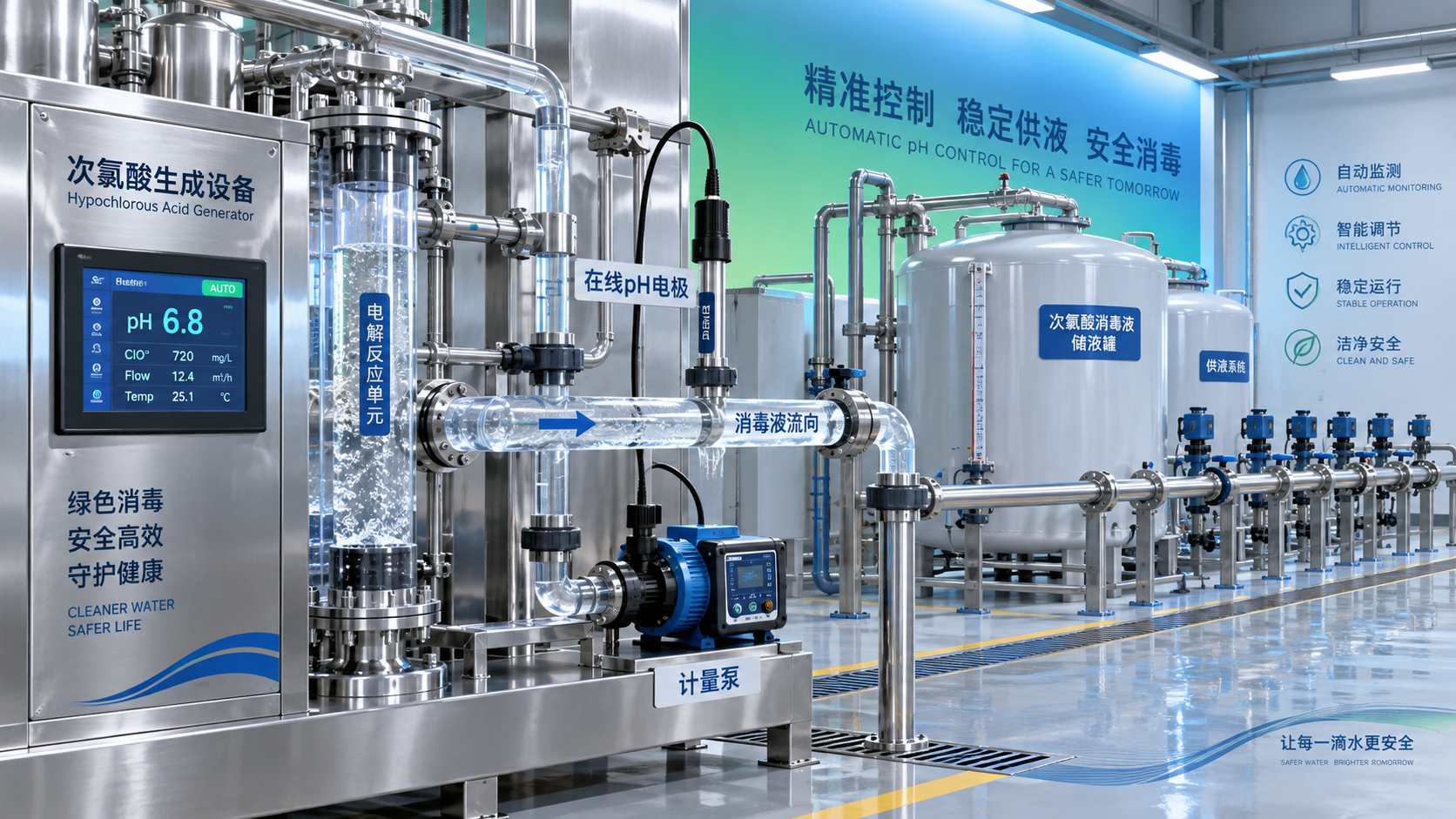
 HClO Generator pH Control: Why It Determines Disinfection Performance
- Which Safety Features Matter Most When Buying an HClO Generator?
 Troubleshooting Low ORP Readings on a Hypochlorous Acid Machine
Leave us a message

Xiaoya Group was founded in 1979,expert in the electrolyzed water industry.
Get in Touch
*We respect your confidentiality and all information are protected.