news
HOCl generators use electricity to convert a controlled mixture of salt and water into a solution containing hypochlorous acid, a chlorine-based antimicrobial compound. The process is called electrolysis. Its success depends on more than adding salt: the device must control the water chemistry, electrical input, flow, and pH to produce a usable solution consistently.
That distinction matters when preparing disinfectant for bathroom surfaces, shared equipment, or animal facilities. Two batches can look identical but have different antimicrobial strength. Understanding what happens inside the generator helps explain why concentration testing, surface preparation, and contact time remain necessary even when production is automated.
From dissolved salt to active chlorine
When sodium chloride dissolves in water, it separates into sodium and chloride ions. These ions allow the liquid to conduct electricity. Inside the generator, a power supply applies direct current across electrodes in an electrolytic cell, driving chemical reactions that would not occur simply by stirring salt into water.
At the positive electrode, or anode, chloride ions can be oxidized to chlorine. That chlorine reacts with water to form hypochlorous acid, written as HOCl or HClO. At the negative electrode, or cathode, water reduction produces hydrogen and hydroxide ions. The generator’s design determines how these reaction products are separated, combined, or controlled.
The chlorine-forming part of the process can be represented by these simplified reactions:
- At the anode: 2Cl− → Cl2 + 2e−
- In water: Cl2 + H2O ⇌ HOCl + H+ + Cl−
- Acid-base balance: HOCl ⇌ H+ + OCl−
These equations explain the chemistry, not a do-it-yourself production method. Commercial systems manage the reactions through cell design and operating controls. Depending on the equipment, membranes, separate liquid streams, or specified pH-adjustment inputs may be involved. “Salt and water” describes the main feed materials, but not necessarily every requirement of every machine.
Why pH changes the finished solution
Hypochlorous acid and hypochlorite ions exist in a pH-dependent balance. At lower pH, HOCl makes up a larger share of the free chlorine; at higher pH, more is present as hypochlorite, OCl−. HOCl generally acts more effectively against many microorganisms at comparable free-chlorine concentrations, although performance still depends on the organism and application conditions.
A mildly acidic operating range is therefore common in HOCl equipment. However, lowering pH without control is not an improvement strategy: excessive acidification can increase chlorine-gas release. Never add household acids, bleach, or other chemicals to the feed or generated liquid unless the manufacturer explicitly specifies that input and procedure.
pH and available chlorine concentration answer different questions. pH indicates the chemical balance; chlorine concentration indicates how much active chlorine is present. A solution can have the intended pH but insufficient chlorine, or the intended chlorine concentration but an unsuitable pH. Neither measurement replaces the other.
Reading concentration without mistaking it for performance
Available chlorine concentration is commonly expressed in parts per million, or ppm. For dilute aqueous solutions, this is approximately milligrams per liter. A reading describes the solution’s chlorine content under the chosen test method; it does not independently prove disinfection effectiveness.
For routine output checks, use the measurement method specified for the equipment and application. Free-chlorine tests and total-chlorine tests are not interchangeable. Select a suitable measurement range and resolution, especially for low-concentration output. Test strips can support basic checks, while a validated colorimetric method may be more appropriate for tighter process control.
Electrical conductivity, oxidation-reduction potential, and a successful production indicator can provide useful operating information. None should automatically be treated as a direct measurement of HOCl concentration. A machine completing its cycle confirms operation, not necessarily that the finished liquid meets the required specification.
What keeps automated production consistent?
A generator balances chlorine production against water throughput. Increasing flow without a corresponding change in production can dilute the output. Variations in salt dosing, electrode condition, or water chemistry can also shift the result, even when the operator selects the same setting.
For a small appliance, these controls may operate within a preset batch cycle. A professional installation may use metering pumps, flow monitoring, and a programmable logic controller. More automation can reduce manual variation, but it still requires calibration, maintenance, and confirmation of output quality.
Where the generated solution fits into cleaning
HOCl is an antimicrobial oxidant, not a universal substitute for detergent. On a bathroom surface, soap film and visible soil can interfere with contact. In a horse facility, bedding debris, manure, and other organic material can consume active chlorine before it reaches the target microorganisms.
A practical surface-disinfection sequence is:
- Remove debris and clean the surface using a compatible method.
- Prepare the generated solution and verify the specified concentration and pH where required.
- Apply enough solution to maintain the required wet contact time.
- Follow the applicable directions for rinsing, drying, and returning the area to use.
The required concentration and contact time must come from validated directions for the intended use. A rapid laboratory result cannot automatically be transferred to a dirty stable floor, porous material, or a different microorganism. Material compatibility also needs checking; chlorine-based solutions should not be assumed non-corrosive under every exposure condition.
A professional system example: interpreting the specifications
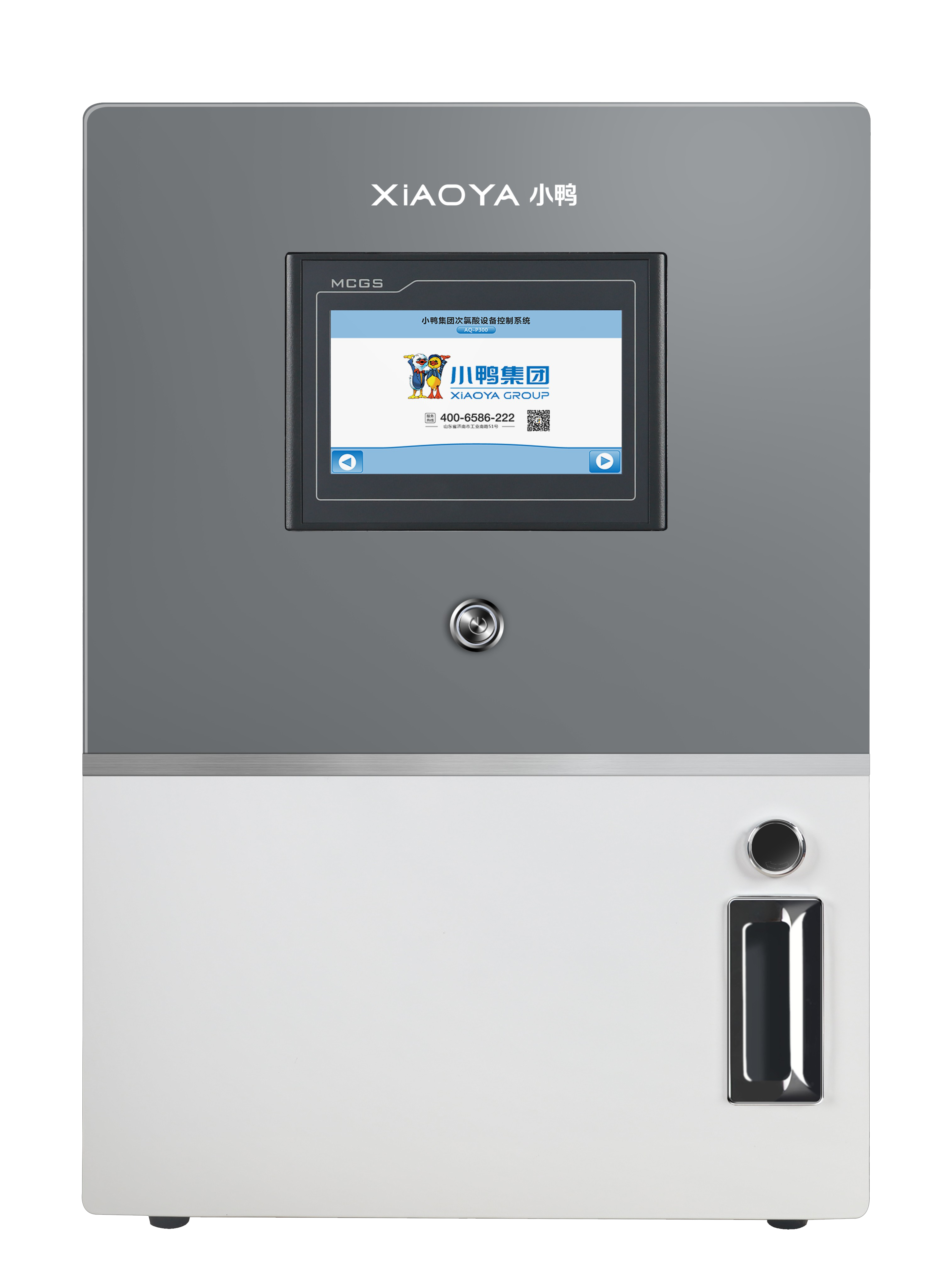
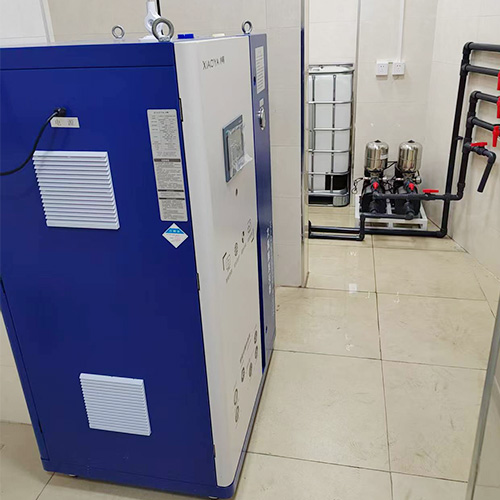
The Hypochlorous Acid Full-Scenario Disinfection System for Horse Farms, model AQ-P300, illustrates the parameters used to describe larger-scale equipment. Its supplied specifications list an output of 180–300 L/h, a pH range of 5.0–6.5, and customizable available chlorine concentration of 10–120 ppm. These describe production capacity and operating ranges, not a single treatment setting suitable for every horse-farm task.
The system also lists PLC touchscreen control with data export and concentration stability of ±10 ppm. That tolerance should be evaluated against the intended operating point: a 10 ppm variation matters much more at the low end of the range than at the high end. Ask how stability is measured, under which feed-water and flow conditions, and whether the controls directly measure chlorine or regulate production through other parameters.
The stated electrolyzer service life is at least 5,000 hours. This is a component-life specification, not a maintenance-free period. Cleaning requirements, water quality, and operating conditions still need to be established before planning routine production.
Confirming that generation translates into usable disinfection
When evaluating HOCl generators, separate three forms of evidence: output measurements establish solution chemistry; performance testing establishes effectiveness under stated conditions; applicable authorization or labeling establishes permitted uses. Equipment conformity alone does not demonstrate that every proposed disinfectant application is approved or effective.
Request operating instructions, water-quality requirements, test procedures, and performance documentation relevant to the intended surfaces and organisms. Verify ventilation and hydrogen-management requirements for the installation. Do not assume that surface use also supports fogging, inhalation exposure, direct animal treatment, or drinking-water use. The useful result is not merely a machine that produces chlorinated water, but a controlled process that delivers a verified solution for a defined task.
NEWS
 Disinfection Empowers Orthodontic Safety: Hypochlorous Acid Generators Build a Sterile Defense Line for Dental Instruments
- Accumulating Strength and Reaching New Heights: A Record of the Production Breakthrough of Xiaoya Small Home Appliances' Hypochlorous Acid Generators
 How Do HOCl Generators Turn Salt and Water into Cleaning Solutions?
 Medical HOCl Generator Procurement: Service, Training, and Traceability
- Integrating a Medical HOCl Generator into Hospital Cleaning Stations
Leave us a message

Xiaoya Group was founded in 1979,expert in the electrolyzed water industry.
Get in Touch
*We respect your confidentiality and all information are protected.