





news
When a school campus, hospital wing, transit terminal, or multi-tenant building runs short of disinfectant, the problem is rarely limited to cleaning staff. Procurement teams may need to approve emergency purchases, facilities managers must find secure storage space, and operations leaders have to decide which areas receive limited stock first. Ready-made products are familiar and immediately usable, but they also create dependence on deliveries, inventory control, and safe chemical handling.
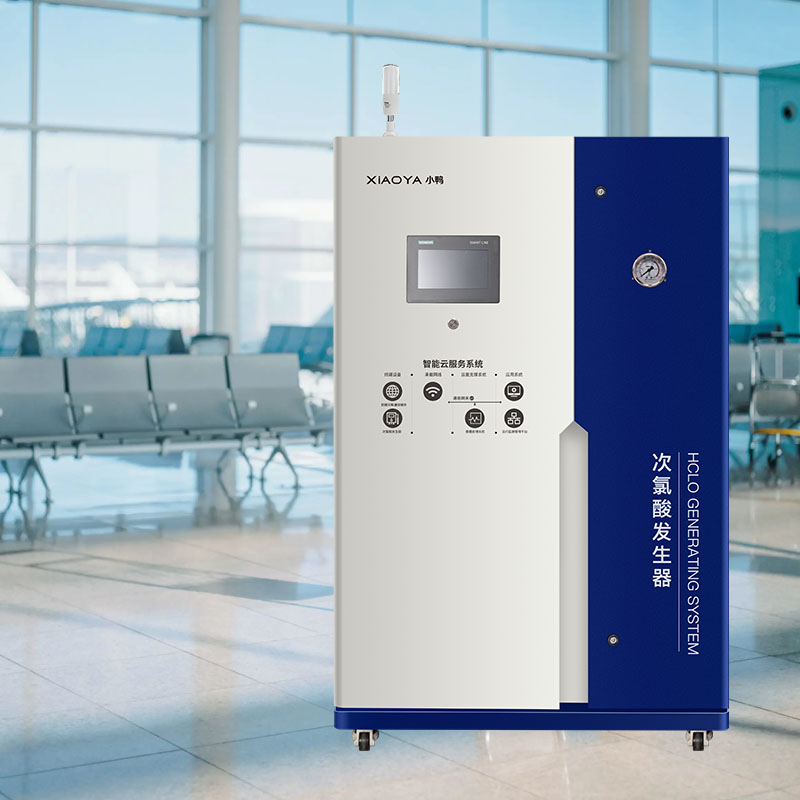
For public facilities with frequent, repeatable disinfection demand, on-site hypochlorous acid production is often the stronger long-term option. A Public Hypochlorous AcidGenerator can reduce reliance on delivered chemical inventory and support routine production near the point of use. It is not automatically the best choice for every site: small facilities with occasional demand may still be better served by ready-made disinfectants. The practical decision depends on consumption patterns, water and power access, staffing, concentration control, and the consequences of a supply interruption.
The operational difference starts before disinfection begins
Ready-made disinfectants arrive as finished products. A facility receives, stores, dilutes where applicable, distributes, uses, and disposes of containers. This is straightforward when consumption is low or use is irregular. It also makes it easier to select a product with a specific labeled application, provided staff follow the intended dilution, contact time, and surface compatibility requirements.
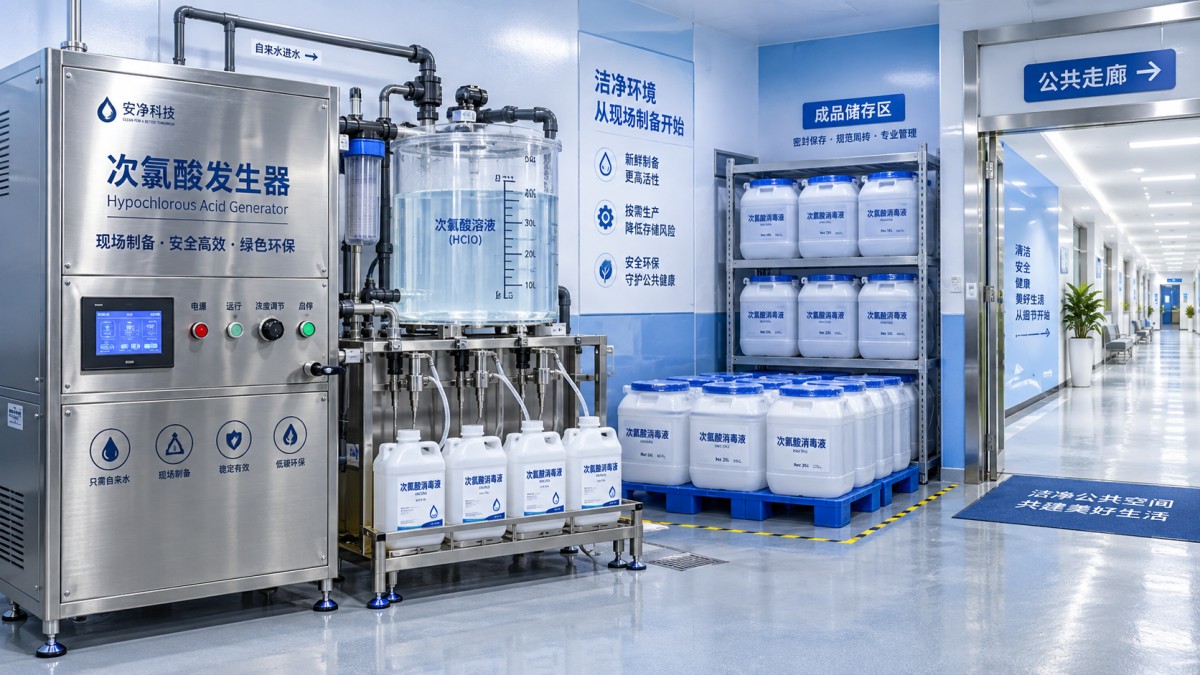
On-site HClO production changes the workflow. Instead of maintaining a large reserve of finished disinfectant, the facility maintains the generator, water supply, electrolyte or consumable inputs, operating procedures, and a defined method for verifying the solution produced. The trade-off is important: logistics risk is reduced, but equipment discipline becomes part of sanitation management.
In a public building with multiple washrooms, entrance areas, dining spaces, elevators, and shared counters, this difference becomes visible quickly. A delivered-product program may involve moving bottles from central storage to many supply closets. An on-site system may allow solution to be generated in planned batches and transferred into labeled application containers or connected to suitable dispensing processes. Neither approach eliminates the need for trained staff; they shift where staff attention is required.
Where ready-made products remain the practical choice
It is easy to treat on-site generation as an automatic upgrade, but that can lead to an unsuitable purchase. A small library branch, a seasonal venue, or an office with limited cleaning activity may not consume enough solution to justify equipment ownership and routine oversight. In these settings, sealed ready-made products can be simpler to manage, particularly when use is limited to a few approved tasks.
Ready-made disinfectants may also remain necessary where a particular application requires a chemistry, concentration, or product registration that HClO is not intended to replace. Public facilities commonly have mixed requirements: general surface cleaning, restroom sanitation, food-service sanitation, odor control, spill response, and specialized clinical or maintenance tasks do not always call for the same product.
The decision should therefore not begin with the question, “Can one system replace every disinfectant?” A more useful question is, “Which recurring tasks consume the largest volume, create the greatest storage burden, and can be managed with a controlled HClO process?” The answer often identifies a sensible hybrid model rather than an all-or-nothing conversion.
When on-site HClO production has a stronger business case
On-site production becomes more compelling when consumption is routine and distributed across the facility. Buildings that repeatedly prepare sanitation solution for public restrooms, common touchpoints, dining support areas, transport-related surfaces, and back-of-house cleaning may be handling enough volume for delivery and storage to become a continuing operational issue.
Supply resilience is another trigger. During periods of high demand, facilities that rely solely on delivered disinfectants can face delayed replenishment or may hold larger stocks than they would otherwise need. Larger inventories create their own problems: purchase forecasting, receiving checks, shelf-life rotation, locked storage, container damage, and disposal of outdated product. Producing HClO on site can reduce these pressures when the unit is correctly sized and there is a documented backup plan for power loss, equipment downtime, or water interruption.
Concentration control deserves close attention. Hypochlorous acid solution is not simply “more effective” at a higher available chlorine concentration. The suitable level depends on the intended task, method of application, contact conditions, material compatibility, and the facility’s internal sanitation procedure. A generator that supports adjustable output can be useful, but only when personnel know which setting is approved for each use and how to prevent containers from being mixed or mislabeled.
Assess the site before comparing purchase prices
Comparing the price of a generator with the price of a few drums or cases of disinfectant can produce a misleading result. The better comparison is the full operating model over the expected period of use. Map the actual demand first: how much solution is used per shift, where it is used, whether it is sprayed, wiped, rinsed, or applied through equipment, and how often supplies are replenished.
- Separate high-volume recurring use from occasional or specialized disinfection tasks.
- Confirm that the proposed installation point has suitable water pressure, drainage arrangements where applicable, electrical supply, ventilation considerations, and secure access.
- Identify who will operate the unit, verify output, clean the system, replenish inputs, and record maintenance.
- Determine how generated solution will be held, labeled, transferred, and used within the facility’s approved time window.
- Retain an alternative product or process for periods when the generator is being serviced or is unavailable.
A decision made from this map is usually more reliable than one based on stated production capacity alone. A unit can produce enough liquid per hour yet still be a poor fit if cleaning teams cannot access it at the right time, storage containers are not managed properly, or generated solution sits unused for too long.
Automation does not remove the need for controls
Automation can make production more repeatable, but it does not replace validation of the operating process. Facilities should establish simple, accountable controls: approved concentration ranges by task, labeling conventions, production logs where required internally, checks on inlet water conditions, and a maintenance schedule. The aim is to make the correct action easier during a busy shift, not to create paperwork for its own sake.
Water quality matters because it can affect generator performance and solution consistency. Before installation, confirm the source water characteristics and the manufacturer’s operating limits. Inlet pressure, electrical requirements, electrolyte handling, and access for servicing should be reviewed as part of site planning rather than after the unit arrives. A compact footprint is helpful only if staff can safely reach the controls, refill required inputs, and perform routine cleaning.
For sites with food-service operations, commissaries, or central kitchens, HClO may have additional relevance beyond public-facing surfaces. The Hypochlorous Acid Generator for Meat Product Disinfection and Fresh-keeping is designed for poultry and livestock processing, deep meat processing, and cold-chain environments, with a production capacity of 160–300 L/h and available chlorine concentration adjustable from 10–120 ppm. Its slightly acidic to neutral pH range of 5.0–6.5 may be relevant where a facility operates controlled food-handling processes, but public-facility managers should still match the equipment to their actual sanitation procedure rather than assume a meat-processing configuration applies to all building-cleaning tasks.
A practical way to choose between the two models
Choose ready-made disinfectants when use is limited, specialized, difficult to predict, or governed by a requirement for a particular finished product. They are also the lower-complexity option where no one can take ownership of generator operation and maintenance.
Prioritize on-site HClO production when the facility has steady consumption, repeated sanitation routines, sufficient utility access, and a team able to manage basic operating controls. The value is usually strongest where reducing delivered chemical stock, simplifying replenishment, and maintaining a dependable daily supply matter more than the convenience of opening a purchased container.
For many public facilities, the most workable procurement decision is to move high-volume routine applications to on-site HClO while retaining ready-made products for exceptions. That approach avoids forcing one chemistry into tasks it was not selected to handle, while still addressing the storage, delivery, and continuity problems that make routine disinfection harder than it needs to be.
NEWS
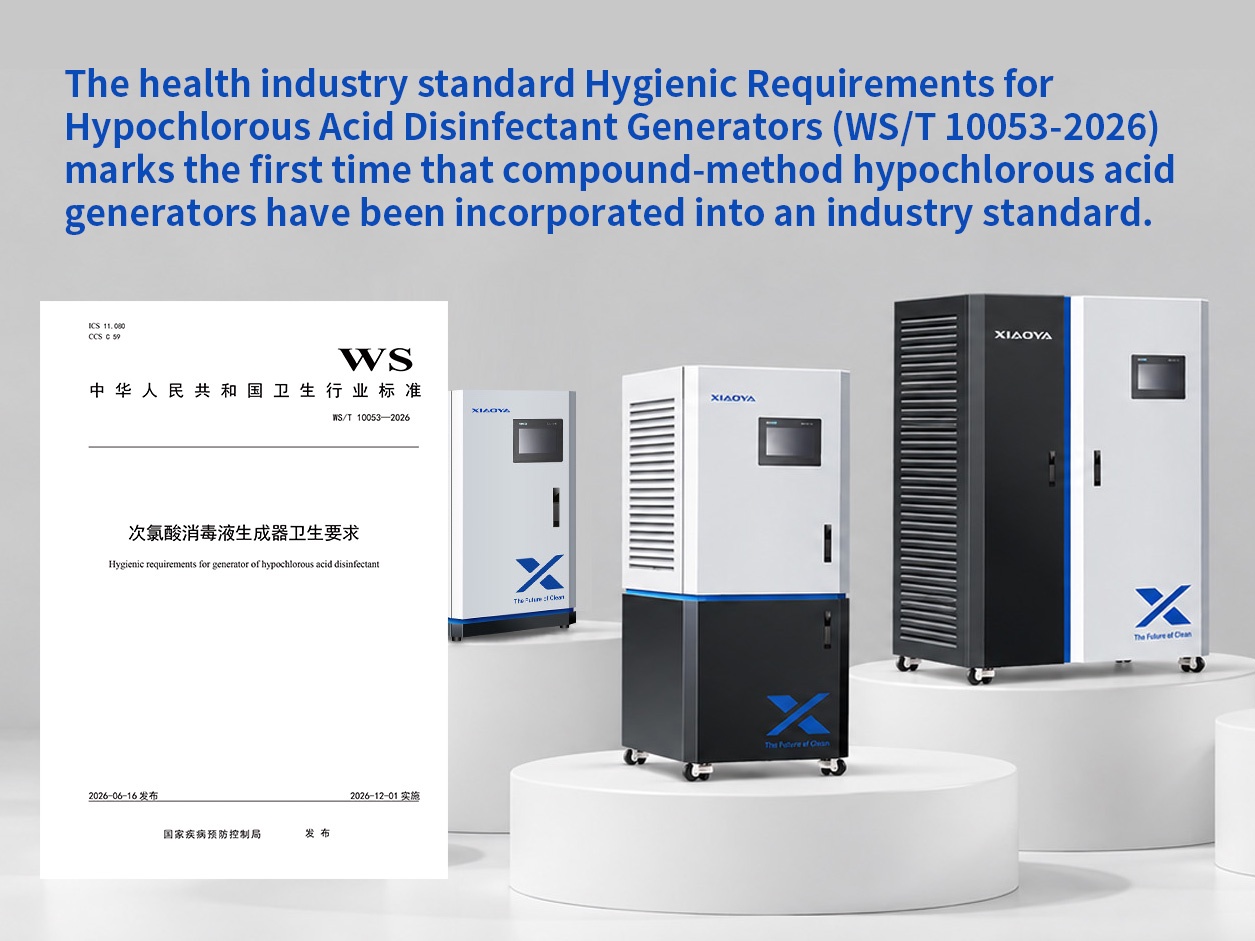
 WS/T 10053-2026 Includes the Compound Method for the First Time: Standard Signals and Market Opportunities for Mass Agricultural Production of Hypochlorous Acid Generators
 Evaluating HClO Generator Lifecycle Costs Beyond the Initial Equipment Price
 HClO Generator pH Control: Why It Determines Disinfection Performance
- Which Safety Features Matter Most When Buying an HClO Generator?
 Troubleshooting Low ORP Readings on a Hypochlorous Acid Machine
Leave us a message

Xiaoya Group was founded in 1979,expert in the electrolyzed water industry.
Get in Touch
*We respect your confidentiality and all information are protected.