




news
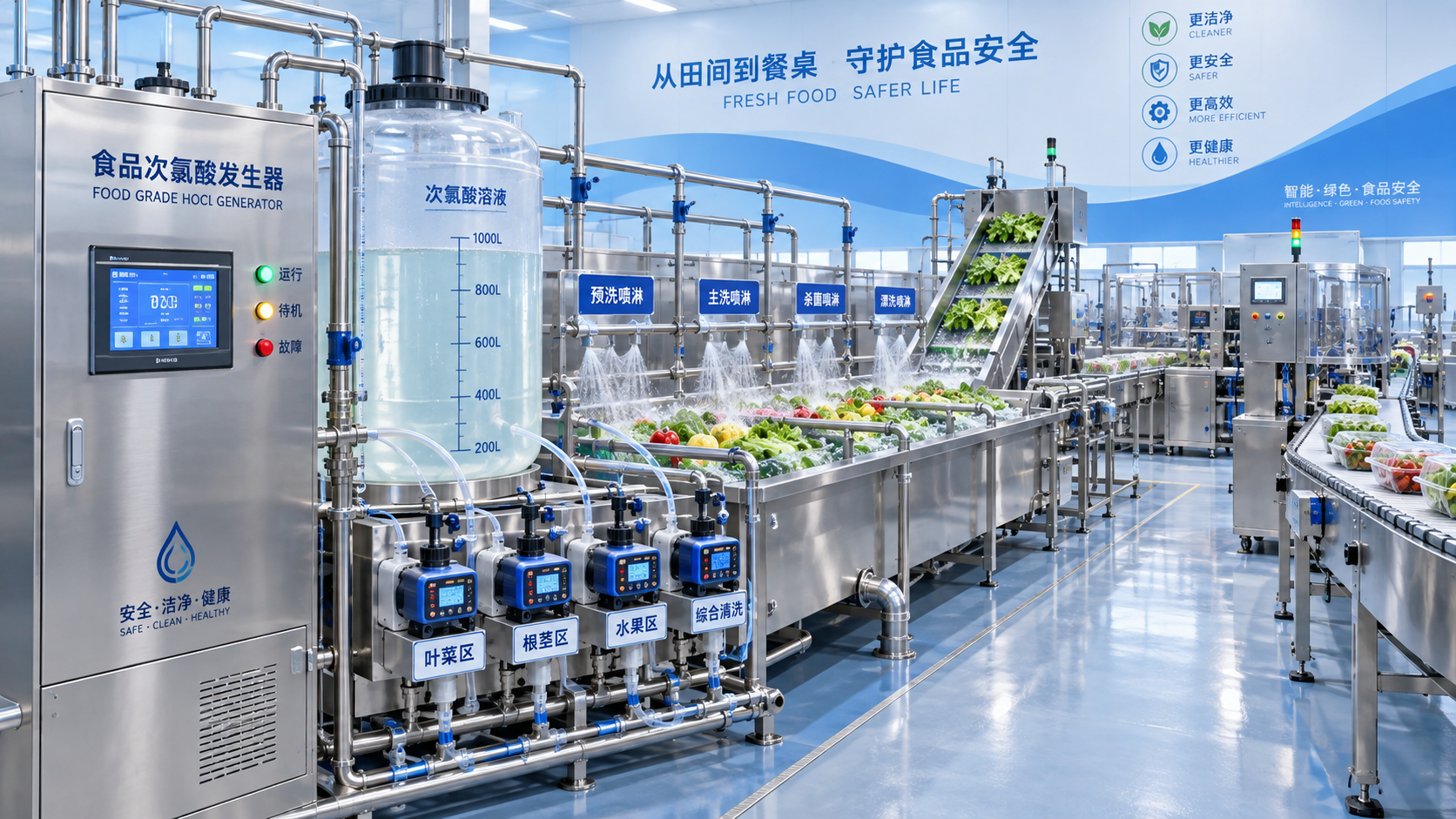
A high-volume packing line does not need the Food Hypochlorous Acid Generator with the highest stated output; it needs the system that can maintain a validated disinfectant dose at the line’s real water demand, without creating sanitation bottlenecks, chemical-handling risk, or unplanned downtime. The decisive question is therefore not “How many litres per hour can it produce?” but “Can it continuously supply usable solution at the required concentration, flow, and control accuracy during peak production and cleaning periods?”
This distinction matters because packing operations may use disinfectant for different points: produce washing, conveyor or crate sanitation, packaging-area surface treatment, boot and wheel hygiene, CIP support, or final rinse applications where permitted by the site’s process rules. These uses do not impose the same demand profile. A generator sized for intermittent surface spraying can be inadequate for a continuous wash flume or multiple dosing points operating simultaneously.
Start with the sanitation load, not the generator label
Procurement specifications should begin with a site sanitation map. Identify every point of use, the water flow at that point, the target available-chlorine concentration or approved application concentration, expected operating hours, and whether demand occurs continuously or in batches. The highest simultaneous demand—not the average daily consumption—should set the capacity baseline.
A line using 4 m³/h of process water requires a fundamentally different solution from one using several small spray stations. Even if both applications use chlorine-based sanitation, the required generation rate depends on dilution, contact time, organic load, water quality, and the permitted operating concentration. A unit’s solution output in L/h is therefore incomplete information unless its concentration is stated and stable under normal operating conditions.
For on-site electrolysis systems, ask suppliers to state capacity in a directly comparable form: grams of available chlorine per hour at specified electrical conductivity, feedwater quality, and operating settings. This avoids a frequent comparison error: treating litres of dilute solution and litres of concentrated solution as equivalent production capacity.
The chemistry also needs careful confirmation. “Hypochlorous acid generator” is often used broadly in commercial searches, but systems may produce electrolysed hypochlorous solution near acidic pH, sodium hypochlorite solution, or another chlorine-based disinfectant stream. These are not interchangeable merely because hypochlorous acid (HClO) is the active antimicrobial species under certain pH conditions. Their storage behavior, pH, available chlorine concentration, dosing arrangement, and suitability for a given food-contact process can differ substantially.
Capacity margin should protect production, not conceal poor sizing
A generator selected exactly at calculated demand has little resilience. Output can be affected by electrode condition, feedwater variability, salt preparation quality, cleaning cycles, ambient conditions, and changes in the line’s water usage. Yet excessive oversizing also has consequences: more capital cost, larger holding volumes, potential loss of solution strength during extended storage, and equipment that may run inefficiently at low duty.
A practical evaluation separates three capacities:
- Generation capacity: the available chlorine mass the electrolyser can produce per hour.
- Buffer capacity: the amount of solution held for peak demand or short interruptions.
- Dosing capacity: the pump and distribution system’s ability to deliver the required volume and concentration to each use point.
Many procurement failures occur at the third level. A properly sized generator cannot compensate for undersized dosing pumps, long pipe runs, pressure losses, incompatible tubing, or a distribution manifold that cannot serve multiple zones independently. Where packing lines have variable speeds or different sanitation programs, separate metering channels and flow verification may be more valuable than simply increasing generator output.
Integration with the packing line determines whether output is usable
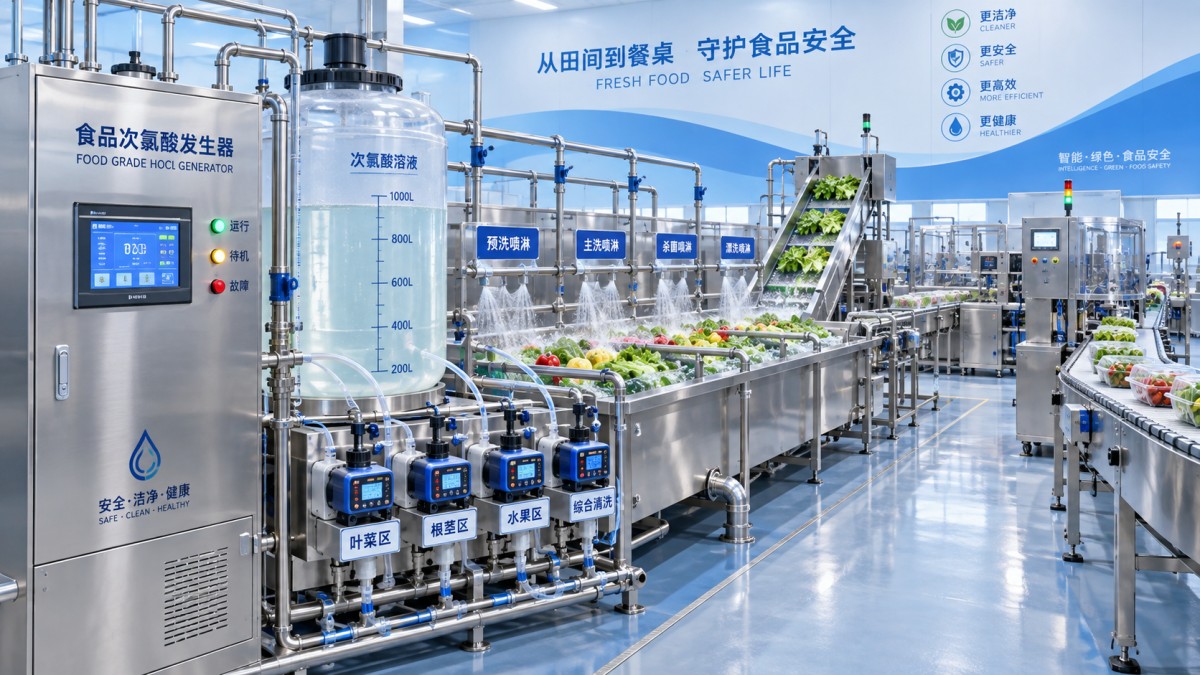
Continuous operations require more than a machine that starts and stops manually. The generator should have a control arrangement that fits the plant’s automation architecture. At minimum, clarify whether the unit can provide alarm outputs for low salt, low water, low tank level, dosing fault, and production fault. For more integrated lines, the requirement may include remote start/stop, demand-based generation, dosing permissives, interlocks with conveyor or washer operation, and communication with the plant PLC or supervisory system.
PLC control can improve repeatability, but “PLC-controlled” alone is not a sufficient acceptance criterion. The procurement specification should define the required I/O signals, communication protocol if applicable, alarm history, calibration access, user permissions, and recovery behavior after a power interruption. A system that resumes dosing without confirming water flow or tank conditions may introduce avoidable process risk. Conversely, a system that requires manual intervention after every routine interruption can reduce line availability.
Physical integration should be reviewed before purchase order release. Check footprint, service clearance, drainage, ventilation, power supply, salt handling route, feedwater connection, drain discharge, and access for replacing consumable parts. A compact cabinet may fit a utility room but still be impractical if operators cannot safely reach the electrolytic cell, chemical tank, pump heads, or sample points.
Water quality is a procurement condition, not an operating detail
On-site chlorine generation depends on feedwater. Hardness, iron, manganese, suspended solids, conductivity, and upstream treatment chemicals can affect scaling, electrode life, output stability, and maintenance frequency. A supplier should not be allowed to quote a performance figure without stating the feedwater assumptions behind it.
Request an incoming-water specification and clarify which pretreatment components are included in the offer. Depending on local water conditions, the package may need filtration, softening, dechlorination, or other treatment. It is also important to distinguish between supplied equipment and site utilities: unclear responsibility for pretreatment is a common source of commissioning disputes.
Salt quality deserves the same attention. If the design requires food-grade salt, the purchase specification should define the acceptable grade and whether anti-caking agents or insoluble residues are restricted. Low-cost salt can create deposits, block injectors, or complicate solution consistency. The cost saving is insignificant if it increases cleaning intervals or shortens cell life.
Verify concentration at the point of use
The generator’s display is not a substitute for process verification. The relevant value is the concentration reaching the application point after dilution, pumping, and transport through the distribution line. Where solution is used on food-contact equipment or in a wash process, the operating program should include a defined method and frequency for checking available chlorine, pH where relevant, and flow.
Sampling points should be included in the design rather than improvised after installation. They need to be accessible, representative, and positioned where they reveal whether the dose reaching the process matches the setpoint. If several branches serve different zones, each critical branch may require separate verification.
For systems described as producing solution within a pH range of 5–6.5 and available chlorine concentrations of 10–120 mg/L, the usable range must be assessed against the actual application rather than treated as universally suitable. A broad adjustable range is beneficial only when the control system can maintain the selected setting and when the process has an approved operating window. Concentration, pH, contact time, temperature, and organic contamination interact; none should be evaluated in isolation.
Compare lifecycle exposure, not just equipment price
On-site generation can reduce dependence on delivered bulk chemicals and avoid storing large quantities of concentrated disinfectant. However, the economic case should include more than salt and electricity. Compare capital cost, installation work, water pretreatment, routine testing, cell replacement, pump consumables, cleaning chemicals, operator time, wastewater implications, validation work, and service response.
Electrolytic cell life should be quoted with its operating assumptions. A stated life of more than 8,000 hours is useful only if the supplier explains the expected water quality, current density, maintenance procedure, and conditions that may invalidate the expectation. Request the replacement cost and lead time for the cell, not simply its nominal service life.
One available configuration, the Sodium hypochlorite generator, is specified with PLC control, food-grade salt as a feed material, and a stated chlorine production figure of 50 g/h. Such a figure may suit defined low-to-moderate demand zones, but it should be converted into the site’s required dose rate before it is considered for a high-volume line. The same product information also lists different solution-output ranges and dimensions, illustrating why procurement documents should require a model-specific data sheet rather than relying on combined catalogue parameters.
Supplier capability is part of the equipment assessment
A generator is a process package, not merely a cabinet containing an electrolytic cell. The supplier should be able to provide a clear process flow diagram, utility schedule, electrical load data, materials-of-construction list, dosing calculation, operating manual, maintenance schedule, spare-parts list, and factory acceptance criteria. PVC may be appropriate for many chlorine-solution handling components, but all wetted materials—including seals, pumps, valves, fittings, and injection quills—must be confirmed for the intended concentration and temperature.
Acceptance testing should focus on measurable operating outcomes: stable output over an agreed run period, concentration accuracy, alarm functionality, dosing repeatability, leak checks, and documented control logic. If the system will be exported or installed across markets, responsibilities for documentation, electrical conformity, local installation rules, and food-processing chemical approvals should be assigned contractually rather than left to commissioning.
The best fit for a high-volume packing line is usually a modular, demand-matched system with independently controllable dosing points, verified output at the point of use, adequate buffer storage, and a supplier willing to specify performance conditions in writing. A larger generator without those controls can become an expensive chemical source that still leaves sanitation quality dependent on manual adjustment. A correctly engineered system turns on-site generation into a controlled utility: predictable, auditable, and capable of supporting throughput rather than interrupting it.
NEWS
 Industry-Academia Collaboration Drives Breakthrough: Xiaoya Small Appliances’ "Smart Adaptive Hypochlorous Acid Electrolysis Module" Approved Under Shandong Provincial Enterprise Technology Innovation Program
- Struggling with Strict Pesticide Residue Limits on Export Farms? This On-Site Disinfection Solution Helps Safeguard Your Quality Standards
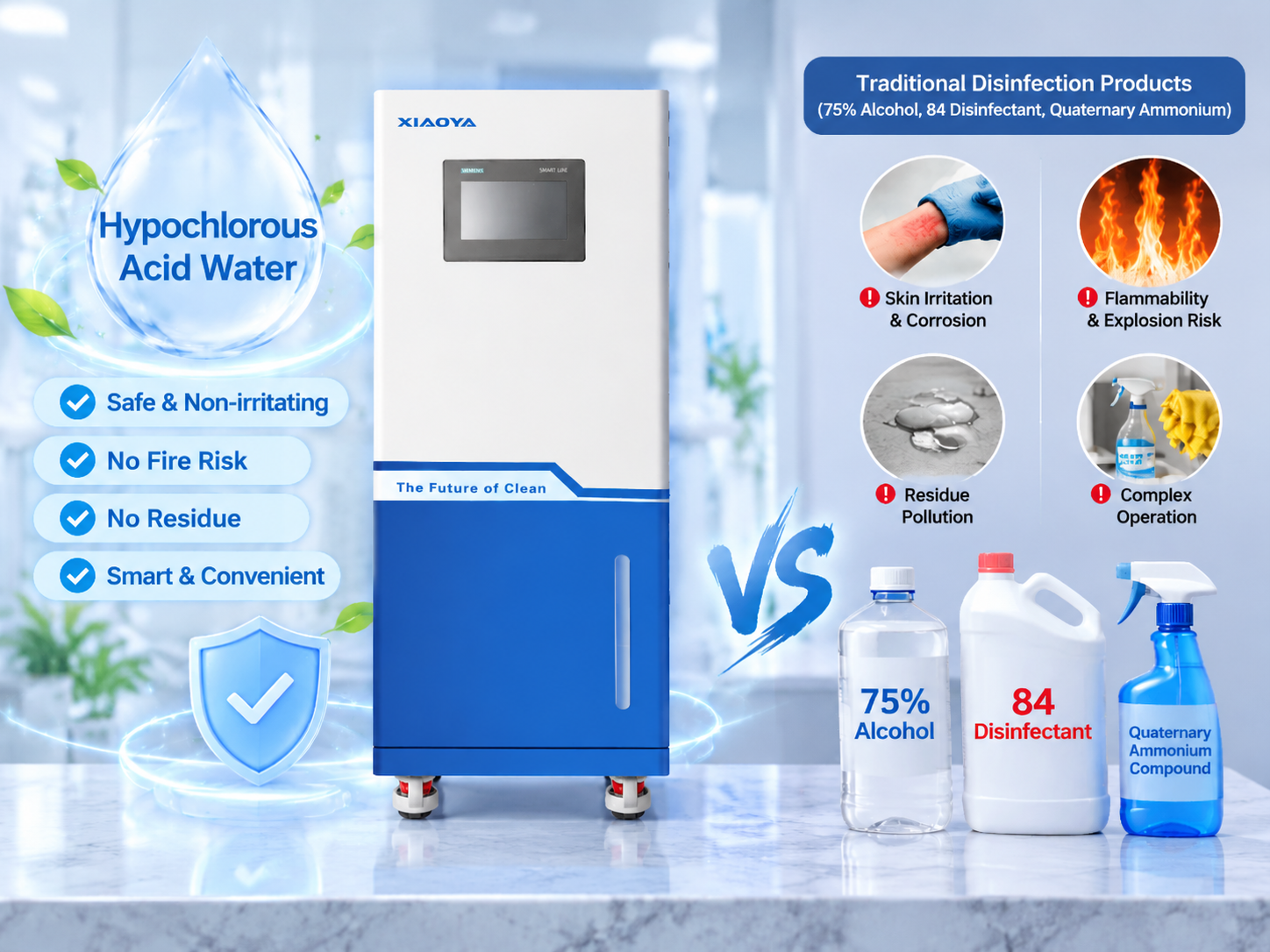
- Hypochlorous Acid Water vs. Traditional Disinfectants
- Tighter Standards Force Disinfection Upgrades: Edible-Salt Hypochlorous Acid Generators Become the "New Standard" in Fresh-Cut Produce Processing
- XIAOYA CIP Electrolyzed Water Generators: On-Site Generation for Food & Beverage CIP Cleaning and Disinfection

Leave us a message

Xiaoya Group was founded in 1979,expert in the electrolyzed water industry.
Get in Touch
*We respect your confidentiality and all information are protected.