news
What Concentration Should a Pet Hypochlorous Acid Generator Deliver?
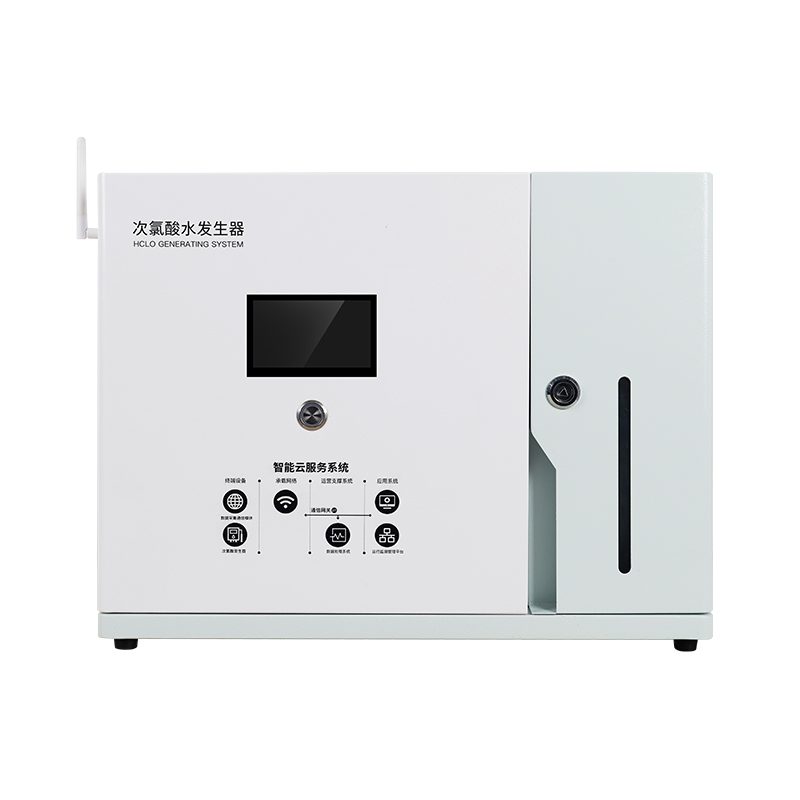
For pet-care operations, the practical answer is not “the highest concentration available.” A Hypochlorous Acid Generator for Pets should deliver a concentration that is validated for the specific task: routine surface sanitation, kennel turnaround, bowl and tool cleaning, odor-control misting, laundry pre-treatment, or pipeline hygiene. These uses have very different exposure conditions, organic loads, and contact-time expectations.
Quality-control teams should therefore specify an output range rather than purchase a generator based on a single headline ppm figure. Hypochlorous acid (HOCl) can be highly effective at comparatively low available-chlorine concentrations when the solution is properly produced, the pH remains in the slightly acidic operating range, and the solution has enough contact time on a clean surface. But a concentration reading alone does not prove disinfection performance.
In a grooming salon, boarding kennel, veterinary waiting area, or pet laundry room, the real question is usually: what concentration can we generate consistently, measure reliably, and use without creating avoidable risk for animals, staff, or equipment?
Start with the application, not the generator rating
As a practical planning reference, many operations evaluate slightly acidic HOCl solutions in a working range of roughly 50 to 200 ppm free available chlorine, with the final setpoint determined by the label claim, use protocol, local requirements, and validation results. This is not a universal prescription. A 50 ppm solution used on a pre-cleaned countertop with adequate wet contact time is not equivalent to 50 ppm sprayed briefly onto a visibly dirty kennel floor.
Routine hard-surface sanitation often calls for the lower-to-middle part of a validated range, particularly where frequent application is needed around animals. Higher working concentrations may be considered for more demanding cleaning-and-disinfection procedures, but only after confirming compatibility, ventilation, rinsing requirements, and the intended microbiological claim. For heavily soiled areas, concentration should not be used as a substitute for cleaning. Hair, feces, food residue, oils, and biofilm consume active chlorine quickly. Mechanical removal comes first.
Why ppm is only one part of the control plan
A common purchasing mistake is to compare machines solely by maximum ppm output. HOCl performance depends on the relationship between available chlorine, pH, oxidation-reduction potential, water quality, temperature, storage time, and application method. In electrolysis systems, feed-water hardness and salt dosing can affect both stability and repeatability. A generator that produces a strong reading on day one but drifts after a water-source change is a quality risk, not a robust sanitation solution.
The distinction between “total chlorine produced” and the biologically useful HOCl fraction also matters. As pH rises, more of the available chlorine shifts toward hypochlorite ion rather than hypochlorous acid. That does not mean every lower-pH solution is automatically suitable for every pet environment, but it explains why ppm without pH is an incomplete specification.
For quality assurance, a sensible acceptance protocol records at least the free available chlorine concentration, pH, production date or cycle, water source, and test point. Test strips may be adequate for quick operational screening when their range matches the solution being tested. Where concentration control supports a formal hygiene program, a calibrated method and written sampling frequency are more defensible.
Animal safety means controlling exposure, not making broad “non-toxic” claims
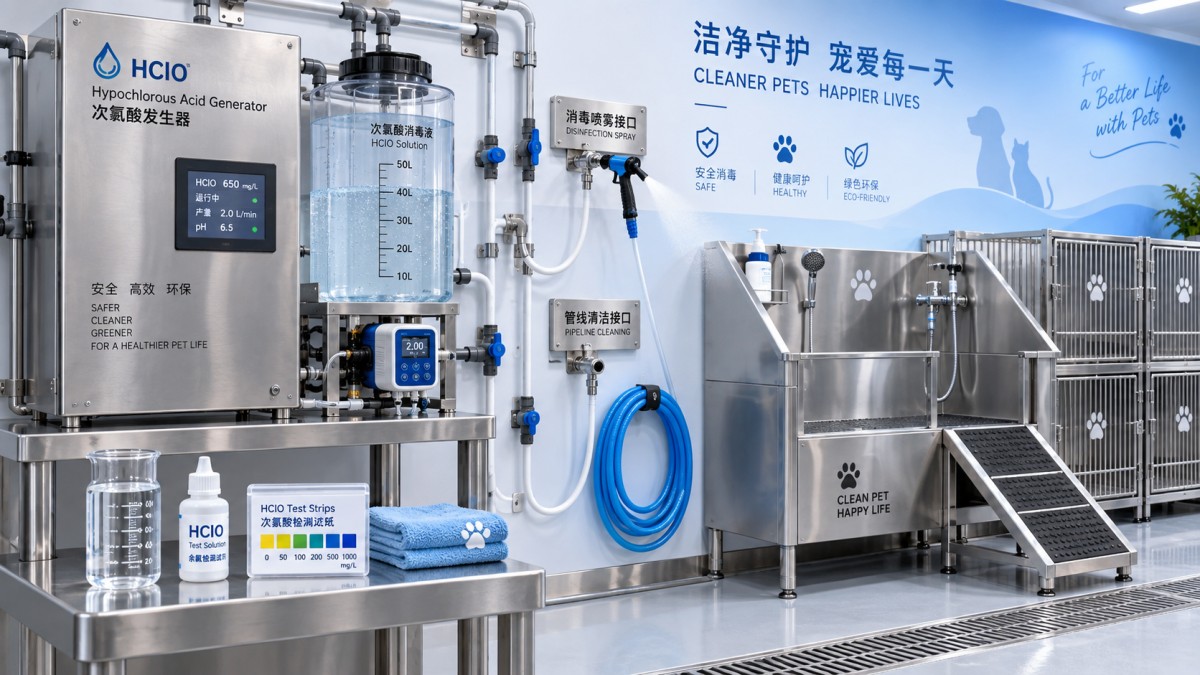
Pet-care environments deserve more caution than an empty commercial room. Animals may lick floors, chew equipment, have sensitive respiratory systems, or react unpredictably to aerosols. A solution intended for hard surfaces should not automatically be assumed appropriate for direct application to fur, paws, eyes, wounds, food-contact items, or occupied-space fogging. Each use must match the product’s validated instructions and the facility’s veterinary or safety guidance.
The phrase “decomposes into water” is often used to describe HOCl after it has reacted or degraded, but that should not be interpreted as permission to ignore handling rules. Freshly generated solution is still an active disinfectant. Teams should prevent accidental mixing with acids, ammonia-containing products, or other cleaners; control spray drift; and keep storage tanks, labels, and dosing lines clearly identified.
Material compatibility needs the same discipline. Slightly acidic HOCl is generally selected because it can be less aggressive than many conventional chlorine products, yet seals, coatings, aluminum components, sensors, and older fittings should be checked under actual concentration and exposure conditions. “Safe for stainless steel” does not automatically mean safe for every assembly installed in a grooming bath or automated washer.
Where automation helps—and where it can hide a problem
Automated generation makes sense when a facility needs frequent, repeatable output across several points of use. It reduces the variability associated with manually diluting tablets or concentrated disinfectants, and it can make sanitation less dependent on whoever happens to be on shift. Manufacturers with experience across health and disinfection equipment, kitchen and bathroom appliances, clean-energy systems, and small appliances increasingly apply similar controls: dosing logic, timed output, tank-level management, and pipeline flushing.
Still, automation can create false confidence. A programmable timer confirms that a cycle ran; it does not prove that the correct concentration reached the far end of a distribution line. Long pipe runs, stagnant branches, poorly maintained nozzles, and diluted residual water can all change point-of-use performance. Commissioning should include testing at the generator, at representative outlets, and after the system has been idle.
This is one reason multi-channel HOCl systems are useful as a design reference. For example, the New-Generation Sanitary Self-Service Laundromat HOCl System Solution combines on-site brine electrolysis with storage, booster pumping, timed control, and separate outputs for atomization, pipeline flushing, and surface sanitation. Although a laundromat configuration is not a pet-care validation, its operating logic is relevant: maintenance lines and sanitation lines should not be treated as the same task, and a three-minute machine self-cleaning cycle is only meaningful when concentration, water delivery, and full pipeline coverage are confirmed.
A better specification for a pet HOCl system
Instead of writing “generator output: 200 ppm,” a stronger requirement is: “The system shall consistently deliver the validated use concentration at each designated point of use, under site water conditions, with documented pH, available-chlorine verification, dosing accuracy, and alarms for abnormal operation.” That language forces the conversation away from marketing claims and toward controllable sanitation performance.
Before approval, ask the supplier to clarify the source-water requirements, expected concentration tolerance, test method, storage-life guidance, maintenance interval, cleaning method for electrodes and tanks, and whether the stated disinfection claim applies to the intended pet-care surface and contact time. If the facility uses the solution in laundry, bathing, spraying, or occupied areas, treat each route as a separate validation question.
The right concentration is therefore not a single number printed on a brochure. For a Hypochlorous Acid Generator for Pets, it is the lowest validated concentration that reliably achieves the required sanitation outcome under real operating conditions—while leaving enough control margin for water variation, application error, and the welfare of the animals in the building.
NEWS
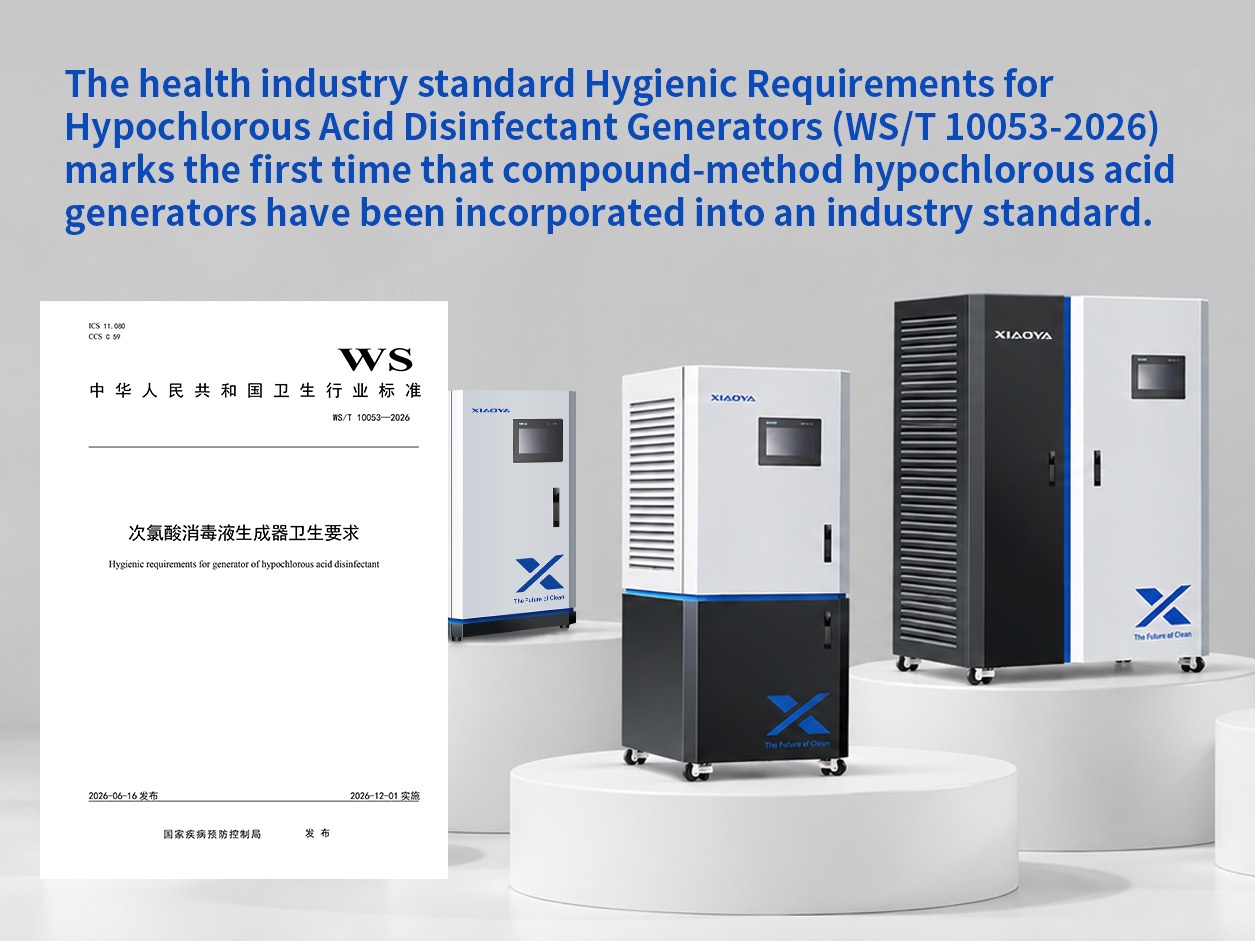
 WS/T 10053-2026 Includes the Compound Method for the First Time: Standard Signals and Market Opportunities for Mass Agricultural Production of Hypochlorous Acid Generators
 What Concentration Should a Pet Hypochlorous Acid Generator Deliver?
 Pet HClO Generator Use for Odor Control in Kennels and Boarding Areas
- Choosing a Hypochlorous Acid Generator for Pets in Grooming Facilities
- Calculating Water, Salt, and Labor Costs for Food HClO Generation
Leave us a message

Xiaoya Group was founded in 1979,expert in the electrolyzed water industry.
Get in Touch
*We respect your confidentiality and all information are protected.