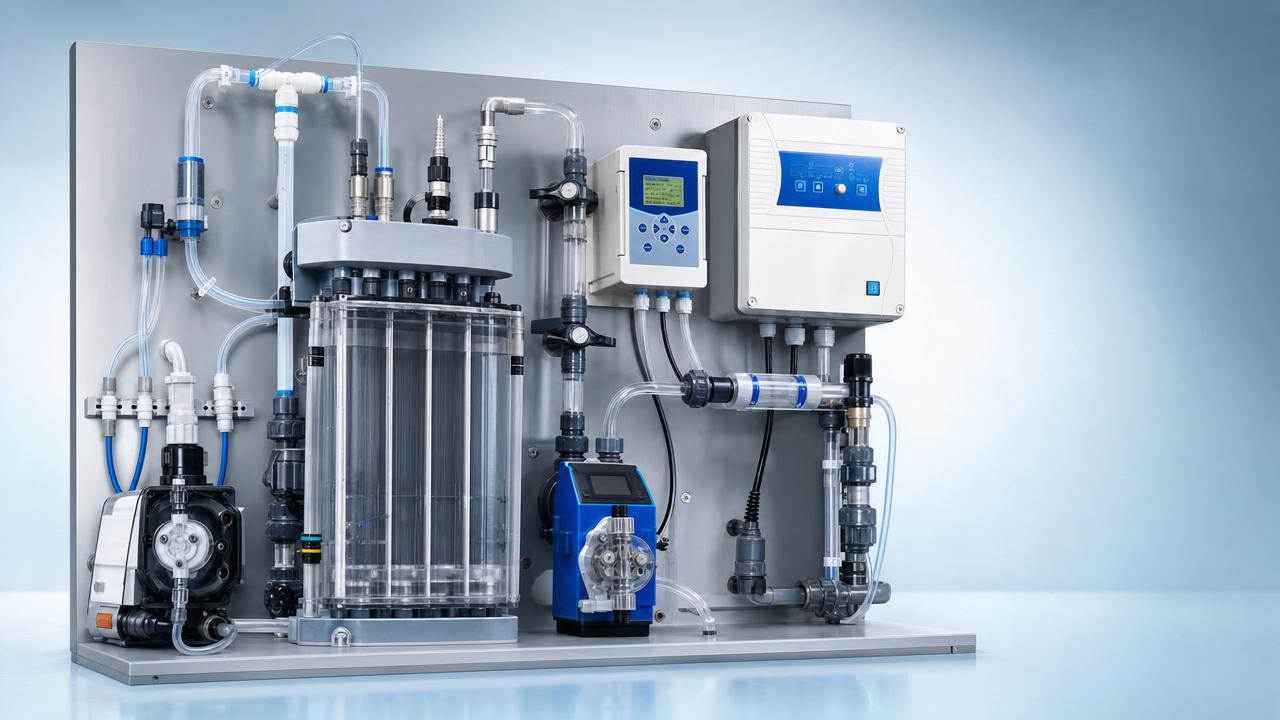
Why does an HClO generator suddenly lose available chlorine?
Low available chlorine is usually the first sign that the HClO generator is drifting away from stable electrolysis conditions.
In automated disinfection equipment, that drop rarely comes from one cause alone.
More often, it comes from a chain reaction involving brine concentration, water conductivity, cell contamination, flow imbalance, or current instability.
In kitchen, bathroom, healthcare, sanitation, and small appliance systems, those variables change faster than many service teams expect.
A quick field check usually starts with four points:
- Confirm whether the salt solution is within the intended concentration range.
- Check inlet water hardness, conductivity, and unexpected contamination.
- Inspect electrodes, membrane surfaces, and tubing for scale or deposits.
- Verify that power supply output matches the controller setting under load.
If chlorine output falls while current appears normal, scale or membrane fouling is often the hidden reason.
If both current efficiency and chlorine value drop together, feed quality or circulation instability becomes more likely.
pH drift looks minor at first, so when does it become a real problem?
A drifting pH is not just a lab number.
It directly changes how much effective hypochlorous acid is present, even when total chlorine seems acceptable.
That means an HClO generator may appear to be running, while actual disinfection performance is already slipping.
In practical service work, pH drift often shows up after prolonged operation, component replacement, or feedwater changes.
Typical reasons include poor separation between anodic and cathodic streams, recirculation imbalance, sensor offset, or aged membranes.
Needless pH correction by dosing also creates trouble.
It can hide the true fault and make the HClO generator less predictable during continuous duty.
A better approach is to compare pH trend, chlorine trend, and flow trend together.
When all three move at once, the issue is usually process-related rather than a single bad sensor.
A simple judgment table helps narrow the fault
Before replacing parts, compare the operating symptoms against the most likely causes.
What makes output unstable even when settings have not changed?
This is one of the most common complaints around an HClO generator in automated appliance platforms.
The screen shows the same setpoints, but chlorine data still moves up and down.
In many cases, the real problem is not the setting.
It is the system’s ability to hold repeatable conditions around that setting.
Start with flow pulsation, backpressure variation, and intermittent air entry.
These are easy to miss, especially in compact equipment integrating pumps, valves, sensors, and electrolysis modules in one enclosure.
Then look at control logic.
If the controller reacts too aggressively to short-term readings, the HClO generator may over-correct and create its own oscillation.
In R&D-to-production equipment lines, stable output usually depends on matching the electrolysis core with the real duty cycle.
For that reason, some systems use a membrane-based cell structure with separated chambers and recirculating electrolysis to improve consistency.
A reference option is the Diaphragm Electrolyzer, which supports modular integration and application-based membrane selection.
That kind of configuration can help reduce crossover effects and improve long-run electrolysis efficiency where chlorine-based disinfectant production must stay repeatable.
Is the fault in the cell, the water, or the control system?
A practical troubleshooting sequence saves time because these three areas often influence each other.
If you start with replacement before diagnosis, the same complaint may return within days.
A useful order is to test the water first, then review electrical loading, then inspect the electrolysis stack.
- Water side: hardness, chloride level, conductivity, and contaminant carryover.
- Control side: current stability, alarms, calibration drift, and feedback timing.
- Cell side: membrane aging, internal leakage, deposits, and chamber separation.
When the water profile shifts with seasonal supply changes, the HClO generator often becomes more sensitive to pH drift and chlorine loss.
When voltage climbs without a matching output gain, the cell usually needs deeper inspection.
Where compact appliance systems run frequent on-off cycles, the control algorithm may also need adjustment to prevent repeated startup overshoot.
Which maintenance habits prevent repeat failures?
The most effective maintenance is trend-based, not alarm-based.
By the time an HClO generator triggers a visible fault, performance may already have degraded for weeks.
A short weekly record is often enough to catch the pattern early.
- Log chlorine value, pH, current, voltage, temperature, and flow at the same production stage.
- Compare startup data with steady-state data instead of checking only one moment.
- Clean deposits before they harden into efficiency loss and pressure imbalance.
- Recheck sensor calibration after replacing pumps, valves, or membranes.
- Review whether the original cell design still matches the present operating load.
In systems serving healthcare, sanitation, or household equipment, service consistency matters as much as peak performance.
That is why some engineering teams prefer modular electrolysis platforms with separated anode and cathode chambers, flexible configuration, and recirculating operation.
Used correctly, a Diaphragm Electrolyzer architecture can support cleaner process control across water treatment, disinfectant generation, and related electrochemical applications.
What should be checked before deciding on a repair or upgrade?
If the HClO generator repeatedly shows low available chlorine, pH drift, and unstable output together, isolated repairs may not solve the root issue.
A better decision comes from reviewing operating history, feed conditions, electrolysis efficiency, and control response as one system.
Pay close attention to whether the problem appears after maintenance, after water source changes, or only during longer duty cycles.
That timing often reveals more than a single spot measurement.
When the same fault repeats, the next step is to define a practical standard:
- What chlorine range is acceptable during real operation?
- How much pH movement is still safe for the application?
- Which trend signals justify cleaning, recalibration, or stack replacement?
- Would a different membrane or modular cell layout fit the duty better?
That kind of review keeps troubleshooting focused and reduces repeat site visits.
For automated equipment expected to deliver reliable disinfection, stable electrolysis is not just a component issue.
It is a system discipline built on correct water input, controlled separation, repeatable power, and maintenance based on real operating data.
NEWS
 Upgrade in Healthy Living: Hypochlorous Acid Generators Become the New Standard for Luxury Villas
- The Ultimate Solution to Pet Shop Disinfection Challenges! XIAOYA Hypochlorous Acid Generator: Safe Pet Protection with Peace of Mind
 Hypochlorous Acid Generator vs Sodium Hypochlorite Generator
- Hypochlorous Acid Generator Supplier
- Hypochlorous Acid Generator Manufacturer
Leave us a message

Xiaoya Group was founded in 1979,expert in the electrolyzed water industry.
Get in Touch
*We respect your confidentiality and all information are protected.