news
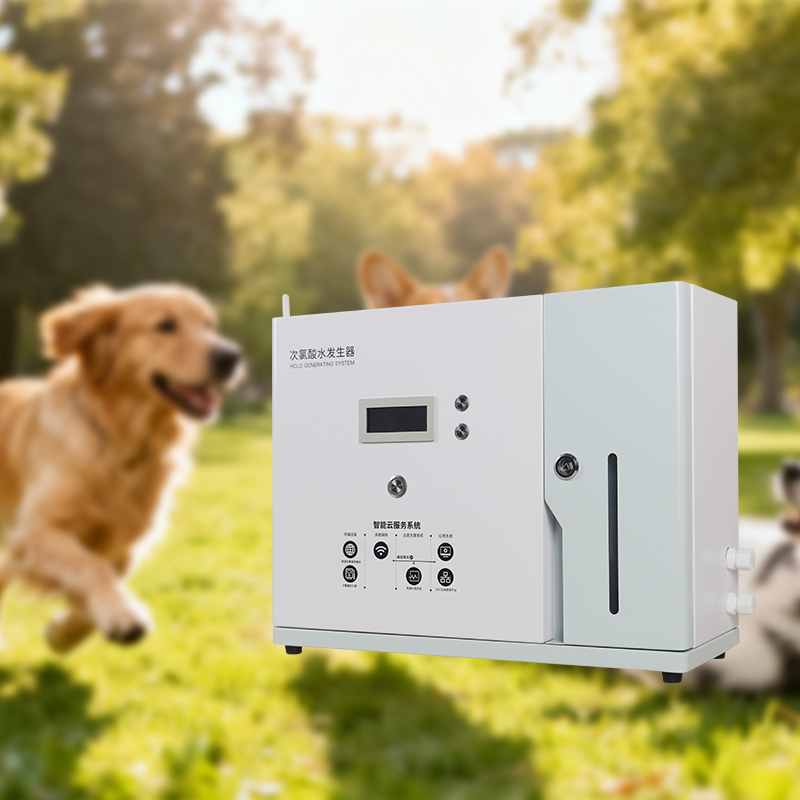
Keeping pets safe while maintaining a clean home is now easier with a Hypochlorous Acid Generator for Pets. Designed for modern households, this pet-safe sanitizing solution helps reduce odors, clean surfaces, and support daily hygiene without relying on harsh chemicals. For families seeking a smarter and gentler way to disinfect pet areas, it offers a practical balance of safety, convenience, and effective sanitation.
Why are more pet owners choosing a hypochlorous acid generator for pets?
Pet households face a daily conflict. They need strong sanitation for litter boxes, feeding areas, carriers, grooming tools, and floors, yet they also want to avoid irritating residues, strong fumes, and overly aggressive cleaning chemicals.
A hypochlorous acid generator for pets addresses that gap by creating a sanitizing solution that is widely recognized for practical hygiene applications when produced and used correctly. In automated equipment, this matters because consistency, dosing stability, and repeatable output directly affect safety and cleaning performance.
For manufacturers and buyers in the appliance sector, the opportunity is larger than a single pet product. Demand now connects pet care with health care and disinfection appliances, small household appliances, and smart home cleaning systems. That is where integrated R&D, production, and operation capabilities become important.
- Pet owners want a sanitizer that supports routine hygiene without leaving a heavy chemical smell.
- Distributors want compact, reliable automated equipment that is easy to position in consumer markets.
- OEM and private-label buyers want stable production, adaptable design, and manageable cost structures.
What makes this category different from ordinary cleaners?
Traditional cleaners are often bought as consumables. A hypochlorous acid generator for pets is an automated device solution. It shifts the value discussion from single-bottle cleaning to controlled on-demand production, operating efficiency, and appliance integration.
Which pet-care scenarios benefit most from automated sanitizing equipment?
The strongest use cases are not limited to one room. A pet-safe sanitizing approach becomes more useful when the home includes repeated cleaning points and odor-sensitive zones. Automation helps create predictable hygiene routines instead of irregular manual disinfection.
The table below shows where a hypochlorous acid generator for pets fits best in real household and light commercial pet-care settings.
These scenarios show why automated equipment is becoming attractive. The value is not only in sanitizing ability, but also in supply convenience, reduced storage burden, and easier alignment with regular cleaning procedures.
How does equipment design affect pet-safe sanitation results?
In this category, output quality depends heavily on equipment design. Buyers should not evaluate a hypochlorous acid generator for pets as a generic appliance. Core performance comes from electrolysis control, material compatibility, water adaptability, and stable operation over time.
Key technical points worth checking
- Electrolysis stability, because uneven generation can affect the usable concentration of the sanitizing solution.
- Component durability, especially for parts exposed to water, electrolytes, and repeated start-stop cycles.
- User interface simplicity, which matters in household appliances where fast, low-error operation is expected.
- Maintenance logic, including cleaning access, replaceable parts, and clear operating prompts.
A company that works across kitchen and bathroom appliances, health care and disinfection appliances, clean energy, and small household appliances is better positioned to optimize these details. Cross-category engineering often leads to stronger automation logic, cleaner product integration, and more practical consumer use.
For example, solutions based on controlled electrolysis may also support broader disinfection and water treatment applications. One relevant option in this field is Pure Hypochlorous Acid (HClO) Electrolyzer, which is positioned around cost-effective and efficient production of hypochlorous acid solution.
Hypochlorous acid generator for pets vs traditional cleaning methods
Procurement decisions become easier when buyers compare equipment-based sanitation with common alternatives. The goal is not to claim one method fits every task, but to understand where automated generation creates operational advantages.
The comparison shows why many buyers see this as an appliance decision rather than a cleaning-product decision. If the need is frequent, repeatable, and spread across several pet-contact points, automated generation usually becomes more attractive.
What should buyers check before selecting a pet-safe sanitizing solution?
Selection often fails because buyers focus on marketing claims and ignore engineering fit. In the automated equipment industry, a better approach is to align the product with use frequency, target channels, production requirements, and after-sales expectations.
Practical procurement checklist
- Confirm the target scenario: home use, pet retail, grooming, or multi-room cleaning. The usage pattern affects output requirements and device size.
- Review material and component design. Water-contact parts should be suitable for repeated electrolysis-related operation.
- Ask about production consistency and supply capacity. For OEM or distribution, stable manufacturing matters as much as product concept.
- Check whether the supplier can support customization, labeling, packaging, and documentation for different markets.
- Clarify lead time, sample process, and technical communication efficiency before placing larger orders.
This is where an enterprise integrating R&D, production, and operation offers a practical advantage. When one partner can coordinate engineering, manufacturing, and delivery, it reduces communication gaps and shortens the path from concept validation to market launch.
Cost, replacement logic, and long-term value
Cost evaluation should include more than the initial machine price. Buyers in automated equipment routinely compare total use cost, replenishment logic, storage needs, and maintenance burden over time.
The table below helps assess whether a hypochlorous acid generator for pets fits a budget-sensitive or scale-sensitive purchase plan.
For many brands, the strongest business case appears when sanitation is not occasional. Repeated pet-area cleaning, refill logic, and household convenience can justify a dedicated appliance more clearly than one-time comparisons suggest.
Common questions and buying misconceptions
Is every hypochlorous acid generator for pets the same?
No. Product differences may include electrolysis structure, operating method, intended output range, maintenance needs, and component quality. Buyers should compare engineering details, not just appearance or retail positioning.
Can this type of equipment be relevant outside pet households?
Yes. The same technology logic may connect with disinfection appliances and certain water treatment applications, which is why suppliers with wider appliance development experience can often deliver more mature solutions.
What do importers and private-label buyers often overlook?
They often overlook documentation readiness, sample adjustment time, packaging coordination, and production communication. A technically promising product can still become difficult if the supplier cannot align development, manufacturing, and order execution.
Is there a scalable component solution for broader disinfection needs?
For projects that require a more technical upstream option, Pure Hypochlorous Acid (HClO) Electrolyzer may be relevant because it focuses on efficient production of hypochlorous acid solution and can align with disinfection-oriented equipment development.
Why choose us for automated pet-safe sanitizing equipment?
Choosing the right partner is not only about finding a product. It is about reducing uncertainty in design, sourcing, delivery, and market adaptation. Our strengths come from long-term involvement in kitchen and bathroom appliances, health care and disinfection appliances, clean energy, and small household appliances, supported by integrated R&D, production, and operation.
- We can discuss product selection based on your target market, usage frequency, and channel positioning.
- We can help confirm technical direction, including functional priorities, appliance integration, and practical use scenarios.
- We can communicate sample support, customization possibilities, delivery cycle expectations, and packaging coordination.
- We can review documentation and general compliance needs relevant to your market entry plan.
- We can provide quotation communication based on volume, feature requirements, and project timeline.
If you are evaluating a hypochlorous acid generator for pets, planning a private-label sanitizing appliance, or comparing automated disinfection solutions for home and pet-care channels, contact us to discuss parameters, model selection, lead time, customization, and sample arrangements in a focused way.
NEWS
 Public Facility HOCl Storage: Managing Heat, Light, and Shelf Life
 On-Site HOCl vs. Purchased Disinfectant for Municipal Buildings
- Sizing a Public Facility HOCl Generator for Peak Cleaning Demand
- What Can a Hypochlorous Acid Generator Do for Public Facility Cleaning?
 WS/T 10053-2026 Includes the Compound Method for the First Time: Standard Signals and Market Opportunities for Mass Agricultural Production of Hypochlorous Acid Generators

Leave us a message

Xiaoya Group was founded in 1979,expert in the electrolyzed water industry.
Get in Touch
*We respect your confidentiality and all information are protected.